
Identifying features
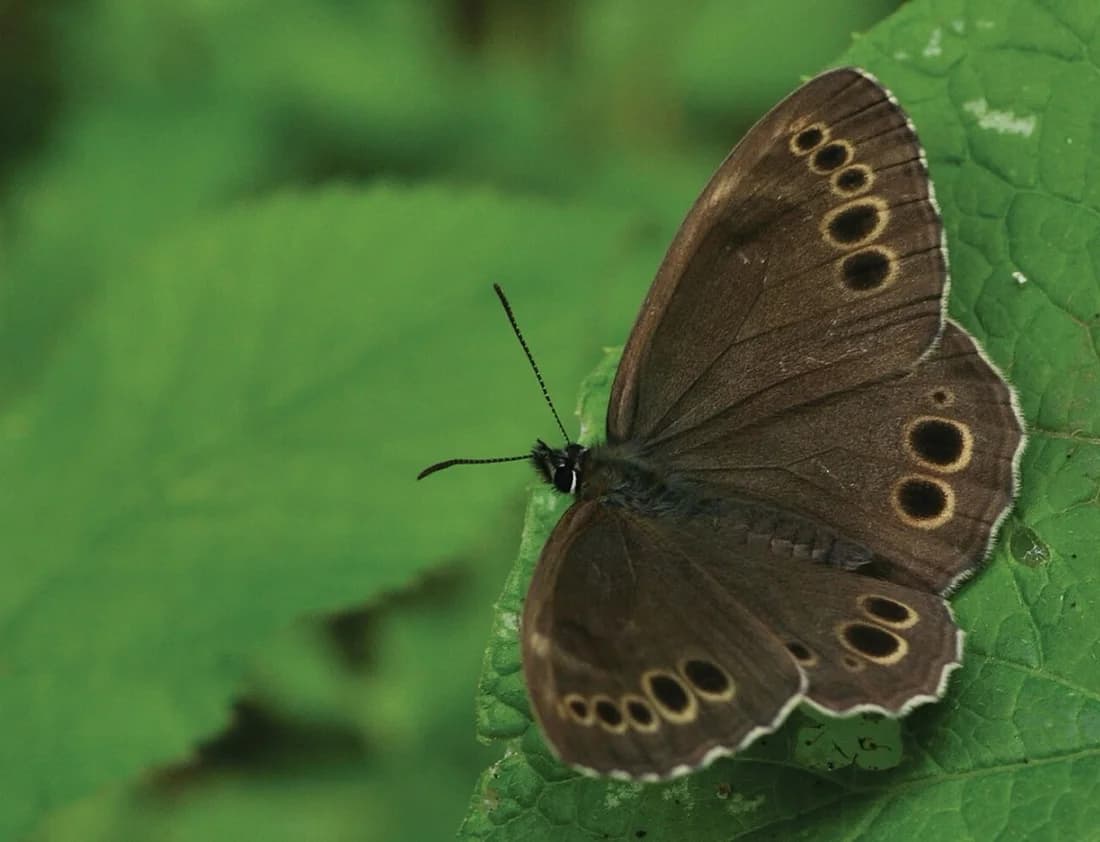
Wingspan 43–50 mm; the female is slightly larger, typically with larger eye spots. The upper side of the wings is dark grey-brown, with five black, yellow-edged eye spots on the forewing, without a white center, and three large, black, yellow-edged eye spots on the hindwing. The underside is greyish-yellow-brown with white-centred eye spots. The wing edges have double, slightly wavy, light yellow border lines, and within the eye spots, a scattered white cross-banding that shines through on the upper side.
Similar species
No similar species are described in the sources consulted.
Distribution
Occurs within two strongly limited areas: in central Östergötland, just south of Östgötaslätten, and centrally in the southern half of Gotland. Also present in a small area west of Ringsjön in Skåne during the 1800s. In Finland, expanding with a focus south of 61°N. The global distribution extends from France and northern Italy through Central Europe and Siberia to Japan, Korea, and northern China. Nationally extinct in several European countries; assessed as near threatened in Europe and within the EU.
Biology
The host plant is Carex species; larvae have also been found on Eriophorum. The female lays eggs while in flight, typically near Carex populations in scrub edges. The larva grows slowly and overwinters in the 3rd instar at the base of a grass tuft; pupation occurs from late May to early June, with the pupal stage lasting 2–3 weeks. Males patrol the sun-exposed sides of scrub edges, searching for unmated females. The butterflies have limited dispersal ability – during marking and recapture, they moved a maximum of 700 metres. They rarely visit flowers, obtaining most of their nutrition from honeydew.