
Identifying features
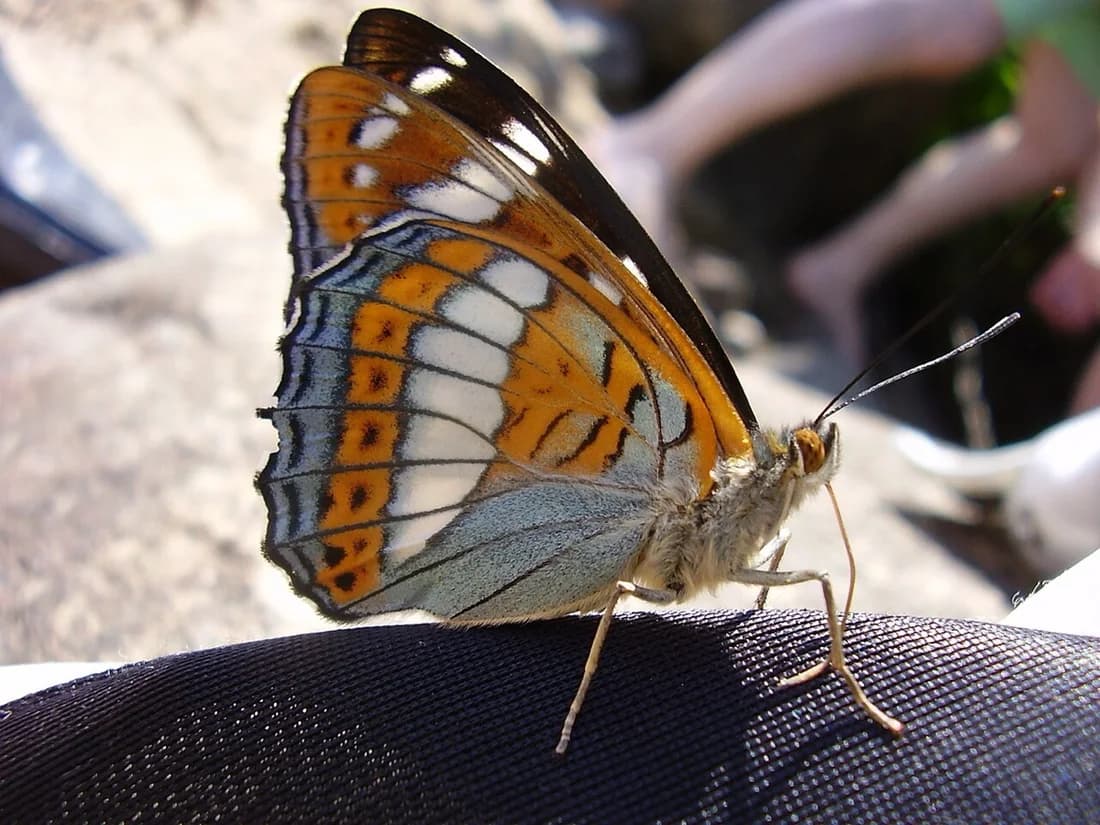
Wingspan 69–90 mm. The female is larger than the male, with broader white transverse bands. The upper side of the wings is black or dark brown, usually with a bluish-green shimmer. The forewing has transverse bands that are resolved into white spots, and the hindwing has a white transverse band with reddish-brown spots one section before the outer edge. This pattern is also found on the underside, which is predominantly rust-coloured and bluish-grey.
Similar species
No similar species are described in the sources consulted.
Distribution
During the 20th century, its range expanded northwards to Västerbotten. It is local and rare in the north and more numerous as far north as southern Dalarna. It is absent near Sweden’s west coast and no longer occurs in Denmark. In Norway it occurs only in the south and southeast; in Finland it has recolonised from the southeast. Its global range extends from France and the Balkans through the Nordic region and Siberia to northern China, Japan and Yakutia.
Biology
The tree is aspen. The female lays eggs, spaced one at a time on the upper side of the aspen leaves. The small larva eats from the leaves, starting at the tip and leaving the central vein; in September, it forms a piece of leaf into a cocoon where it overwinters. After overwintering, growth is significantly faster in May-June, and the larva pupates hanging from the leaf attachment; the pupal stage lasts approximately three weeks. It is almost exclusively the males that come down to ground level, where they land at puddles on gravel roads to suck up moisture and salt. Newly emerged butterflies are fearless and curious, and often land on sweaty people.