
Identifying features
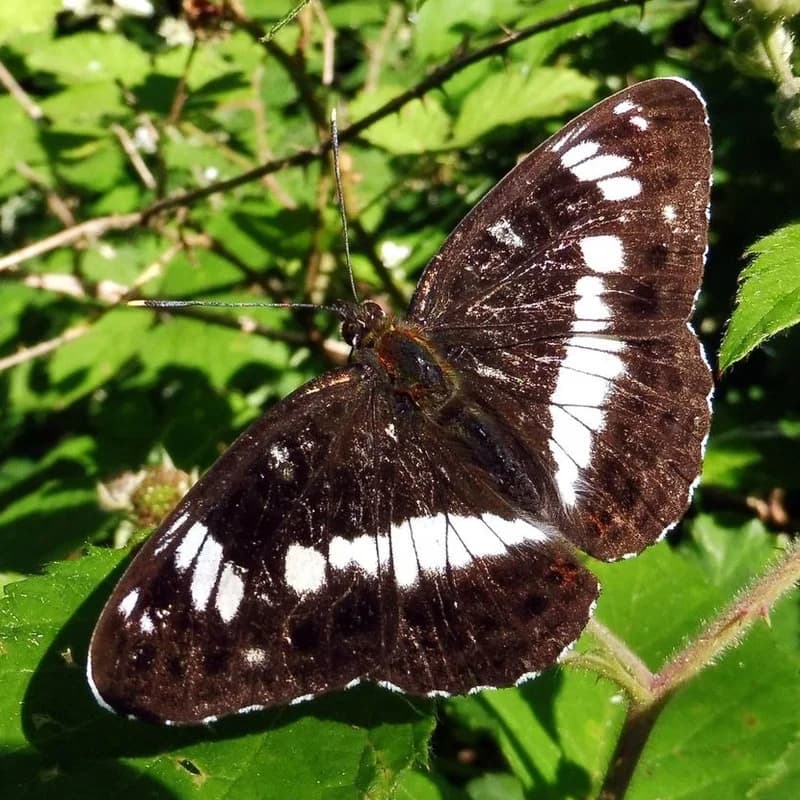
Wingspan 48–59 mm. The upper side of the wings is dark brown with broad white bands, which on the forewings are divided into spots. Outside the bands, there are on both pairs of wings, double rows of small black spots. The underside is cinnamon brown with the same white bands and black spots, as well as a broad, light bluish-grey area from the base of the hindwing to the corner. The female is larger than the male, with more rounded forewings and broader white bands.
Similar species
A smaller copy of the more well-known Poplar Admiral (Limenitis populi). A small white admiral can be mistaken for a large female of Map (Araschnia levana) from the second generation.
Distribution
Formerly established in Sweden for a short period, with the first confirmed record in Skåne in 1946. It then became extinct, the last known individuals being recorded at Stenshuvud in 1969. It was rediscovered on Falsterbonäset in 2003 and has been resident in Järavallen nature reserve since 2016. More recently it has also reappeared elsewhere in Skåne, with occasional confirmed records in Småland and Uppland. Known from Denmark since the 19th century and expanding in the Baltic states. Its world distribution is divided into two areas: Europe, from the Atlantic coast of France to the southern Urals, and Asia, from Amur to Japan and Korea.
Biology
The host plant is wild honeysuckle (fly honeysuckle in the Baltic). The female lays eggs sporadically on the edges of older honeysuckle leaves in partial shade, at a height of 2–3 metres above the ground. The larva attacks the leaf from the tip, leaving the central vein intact. In late August or early September, it spins a partially eaten leaf into a cocoon, where it overwinters; in April, it leaves the cocoon and undergoes pupation in early or mid-June. The pupal stage lasts 2–3 weeks. The butterflies remain at tree top height, but visit flowers, gravel paths with water and salt, and fermented fruit juice.