
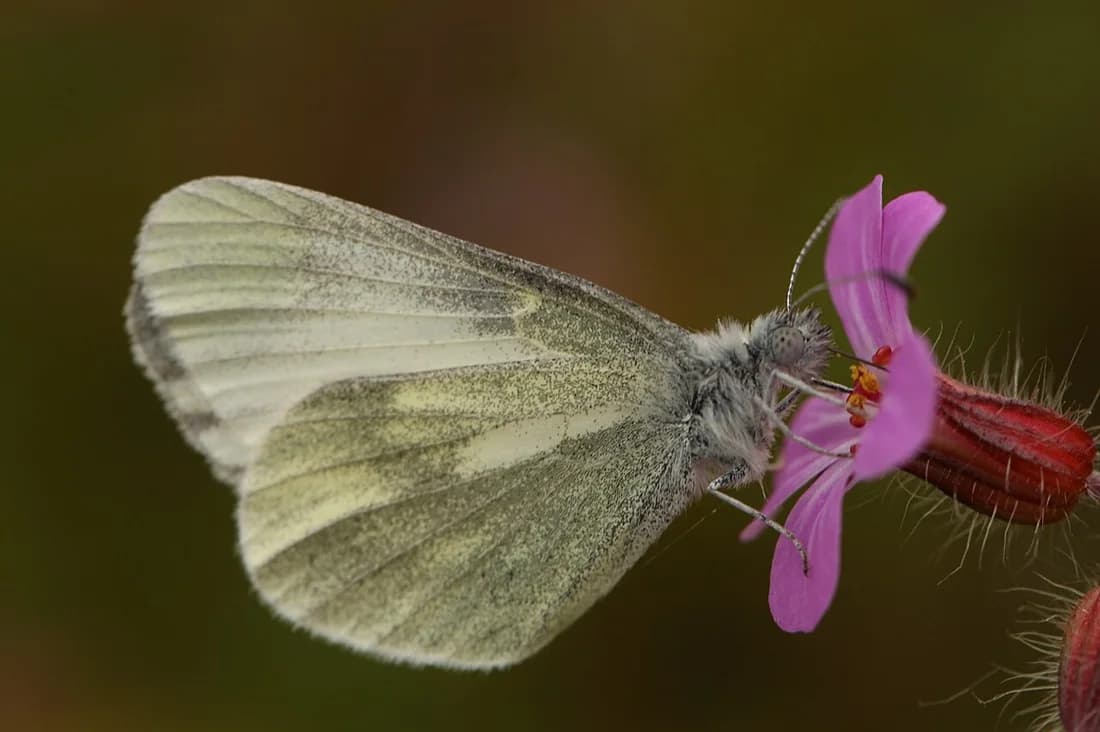
Identifying features
Wingspan 36–44 mm. The species is almost identical to Wood White. The males of the first generation of Cryptic wood white have more black pigment in the apical spot and a sharper, more defined apical spot, often with dark wing scales forming clear lines on the Cu1 and Cu2 wing ribs. The males of the second generation of both species are barely distinguishable.
Similar species
The species is almost identical to Wood White, and the two species are so similar that it is almost impossible to distinguish individual specimens in the field. However, the flight period and host plants differ, so populations can be quite reliably distinguished based on their habitat.
Distribution
Cryptic wood white has a slightly more eastern distribution in Scandinavia than Wood White, and is, for example, the more common species in eastern Svealand. Sweden has been found in Sweden from Småland, Västergötland, and Bohuslän, northwards to Västerbotten and the Åsele Lappmark, including Öland and Gotland.
Biology
The eggs are laid scattered on host plants, among pea plants. The species prefers open meadow habitats, while Wood White is more closely associated with forest glades.