
Identifying features
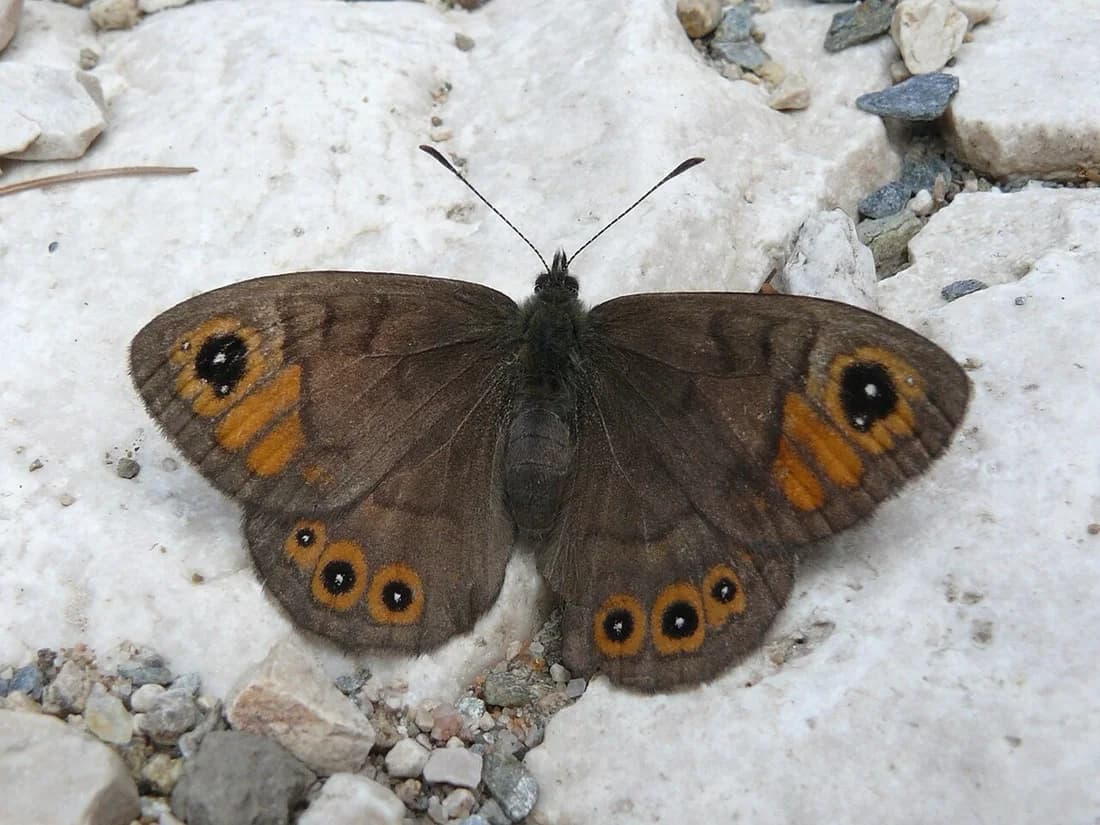
Wingspan 34–42 mm. The upper side of the wings is dark brown with black, white-centred eye spots: on the forewing, a larger eye spot and often two eye points, and on the hindwing, 3–4 smaller eye spots. Red and yellow patches spread around the eye spots. The underside of the hindwing is grey-brown with mottled, wavy bands and 6–7 eye spots. The female lacks scent scales, is larger than the male, and has more extensive red and yellow patches.
Similar species
Very similar to large wall brown (Lasiommata maera), but Northern wall brown is smaller and typically has more and clearer dark cross-lines on the forewing, and sometimes a cross-line on the hindwing.
Distribution
Sweden represents a fairly common lowland species, rarer along the mountain ranges and along the west coast; possibly absent from Scania, absent from Öland but common on Gotland. Denmark found only temporarily. Its global distribution extends from isolated occurrences in the Pyrenees and the Alps, and more consistently from Fennoscandia through western Russia and Siberia to the Amur River. It is considered viable in Europe, but close to threatened within the EU.
Biology
The eggs are laid scattered on the heath and redwing, possibly also on rocky hills; egg development takes 1–2 weeks. The larvae feed on leaves, are well camouflaged and difficult to find, and growth until pupation takes 3–5 weeks. Overwintering always occurs in the pupal stage, with the pupa attached to rocks. The butterflies are very shy, fly quickly and erratically when disturbed, and are locally loyal.