
Identifying features
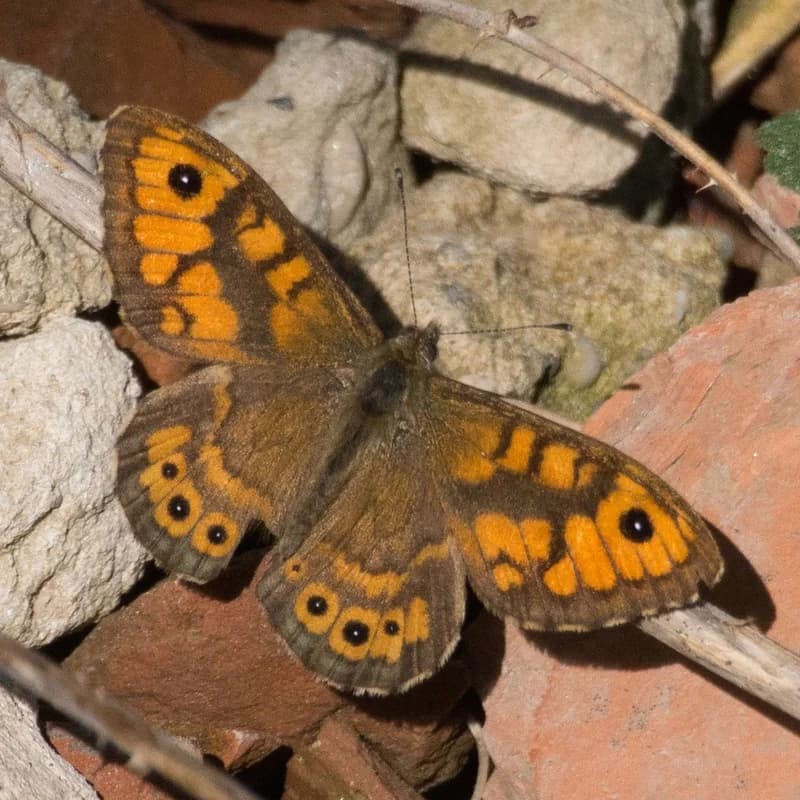
Wingspan 35–42 mm; the female is larger with more extensive light areas. The upper sides of the wings are brown to dark brown-grey, with large, reddish-yellow spots that merge into large fields, only outlined by darker, brown veins. On the front wing tip, there is a larger eye spot, and on the upper side of the hindwing, there are 3–5 smaller eye spots. The underside has 6–7 more discreet eye spots against a light grey, brown, and brass-coloured camouflage pattern.
Similar species
No similar species are described in the sources consulted.
Distribution
In Sweden, in the southern part of the country, including Öland and Gotland; previously mainly in coastal areas, now also in inland areas, and the distribution is constantly changing. Denmark found throughout the country; primarily older finds in Finland. The global distribution encompasses all southern Europe up to England, Ireland, and Scandinavia, as well as North Africa, Turkey, and Iran.
Biology
The host plants are grasses, including cocksfoot, crested dog’s-tail, smooth meadow-grass, heath-grass, red fescue and sheep’s fescue. Egg development takes about one week and larval development 3–5 weeks. The pupal stage lasts 2–3 weeks, or the pupa overwinters. In areas without cliffs, males are attracted to stone walls; in rocky landscapes they gather at hilltops. This mate-seeking behaviour is called hilltopping. The species is sensitive to climate and its population density varies greatly.