
Identifying features
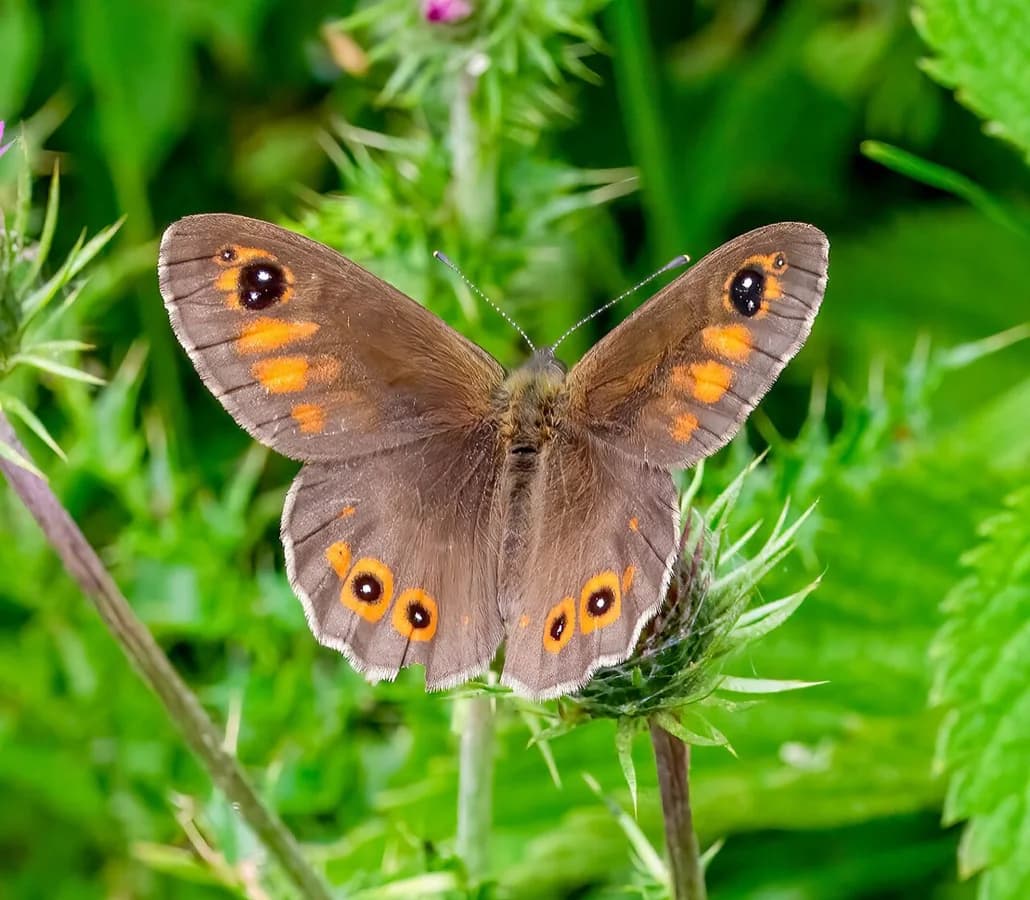
Wingspan 42–52 mm; the female is slightly larger than the male. The upperside of the wings is dark brown, sometimes with a faint reddish sheen. The forewing features a larger black eyespot with a white core, sometimes surrounded by 1–2 smaller eyespots; on the hindwing, the male has 2–3 and the female has three eyespots with reddish-yellow rings. The underside of the hindwing is grey-brown mottled, with wavy cross-bands and 5–7 eyespots.
Similar species
Very similar to Northern wall brown (Lasiommata petropolitana), but large wall brown is larger and lacks more distinct dark cross-lines on the upper sides of the wings.
Distribution
Generally, in the larger area of Sweden, from Skåne to Västerbotten and southern Lapland; absent in Gotland and rare on the west coast and at the northern border. Noted in Norway at 68°N. Sporadic in Denmark. The worldwide distribution extends from the Atlas Mountains in North Africa, through all of Europe and Turkey, to Altai, Kazakhstan, and Iran.
Biology
She lays her eggs scattered, one by one on grass blades. Well-known host plants in Central Europe include backskafting, bergrör, sheep’s fescue, kruståtel, rödsvingel, and stagg; in Sweden, the number of host plants is certainly greater. The larvae overwinter in the 3rd stage and undergo pupation by the end of May; the pupal stage lasts 2–3 weeks. The males establish territories in areas with both bare rock and nectar resources. The butterflies are active throughout the day and are often among the last butterflies seen in motion at sunset after a warm summer day.