
Identifying features
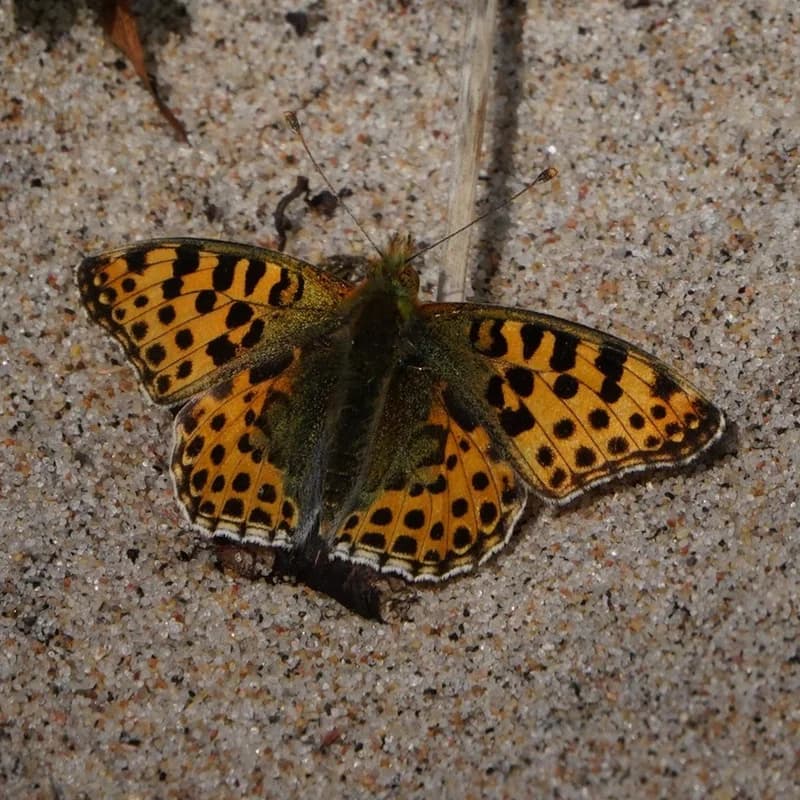
Wingspan 35–50 mm; dwarf specimens with 30–35 mm are found quite often. The upper sides of the wings are light reddish-yellow with rounded black spots and lack darker wing veins; the wing shape is somewhat angular, similar to Map. The underside of the hindwing has larger silver spots and more eye spots with silver-coloured nuclei than any other species. The female is larger, with more greenish sheen in the dark brown base of the wings.
Similar species
No similar species are described in the sources consulted.
Distribution
The number and distribution fluctuate significantly; during years of population growth, it is found everywhere in southern Sweden. The permanent breeding areas are likely located in coastal areas from Skåne to eastern Svealand. Sporadic in Dalarna and northwards, up to Västerbotten. Across Europe, except for the Norwegian coast and Britain. The global distribution extends from North Africa and Europe to northern India, Afghanistan, and Mongolia.
Biology
The eggs are laid scattered on leaves of common valerian and meadow violet, or on dry plant debris in their vicinity. The larval development during the summer can be very rapid, taking only two weeks, provided favourable weather conditions. The offspring of the second generation overwinter in the 3rd–4th instar and complete their growth in April–May. The pupa hangs low in the vegetation and hatches after 1–2 weeks. During years with significant population growth, the species migrates and can then be found almost everywhere, but always seeks out dry areas.