
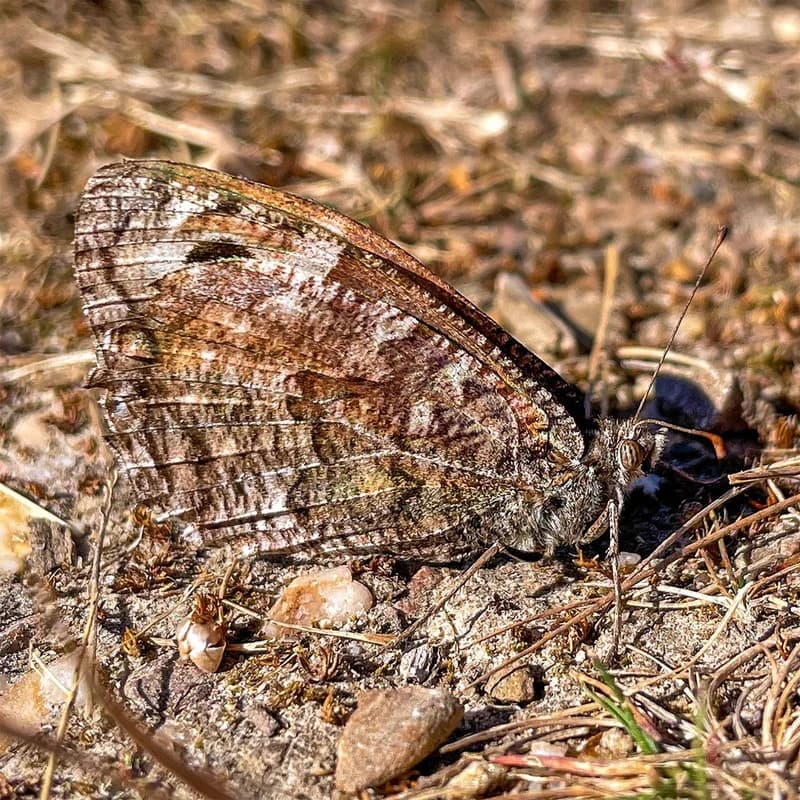
Identifying features
Wingspan 44–55 mm for the nominate form; the subspecies tristis on Öland and Gotland is significantly smaller (36–46 mm) with paler yellow cross-bands. The upper side of the wings is grey-brown with broad ochre and yellow cross-bands; the forewing has normally two eye spots with a white center, and the hindwing one. The underside is speckled in white, grey, brown, and black. The male is smaller than the female, with smaller eye spots and a darker scent scale band at the forewing’s disc.
Similar species
No similar species are described in the sources consulted.
Distribution
In Northern Europe, primarily along the coastlines: from the southern coast of Norway, along the entire Swedish coastline, to central Uppland, the Åland archipelago, and Denmark. In inland areas, it was formerly widely distributed, but today it is likely only found in a few locations near Lake Vänern, Lake Vättern, and eastern Lake Mälaren. The subspecies tristis is common in the areas of Öland and Gotland’s heathlands, and is permanently established on Gotland’s Sandön. The global distribution encompasses most of Europe.
Biology
The eggs are laid scattered on both decaying and green blades of grass; egg development takes 2–3 weeks. The larvae are entirely nocturnal, grow slowly, and overwinter in the base of a grass clump in the 2nd–3rd stage. Growth continues until June, when they pupate in a loose silk cocoon made of compacted sand grains; the pupal stage lasts 4–5 weeks. On sand dunes, the larva has been found on sand roots; other possible host plants include sheep’s fescue, scarlet elf, butter plant, and common plantain. The males maintain territories on bare rocks or sandy ground covered in moss.