
Identifying features
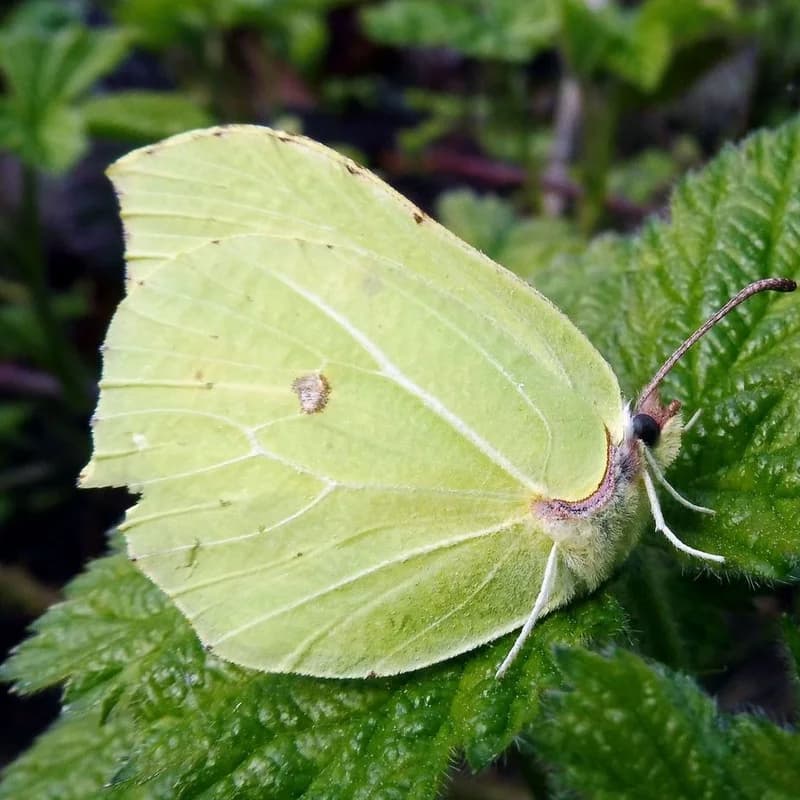
Wingspan 55–60 mm. The wings are broad with pointed front edges and a pointed midpoint on the outer edge of the hindwing. The male is lemon yellow, while the female is pale greenish-white. Both sexes have small orange spots in the center of both pairs of wings. The antennae are unusually short.
Similar species
No similar species are described in the sources examined. The male’s lemon-yellow colour and pointed wing shape are unmistakable.
Distribution
In Northern Europe, common brimstone is widespread and common in all southern regions and provinces. The northern limit extends from Sör-Tröndelag in Norway to Bottenviken, but the species is rarer north of central Sweden. Its global distribution extends from North Africa through Europe, Turkey, the Caucasus, and Siberia, to northern Burma and Japan.
Biology
The eggs are laid scattered on branches of willow or pear. Egg development takes one week; the larva grows and pupates often on the same branch, which takes approximately one month, and the pupal stage lasts barely two weeks. The female can produce more than 500 eggs during her lifetime.