
Identifying features
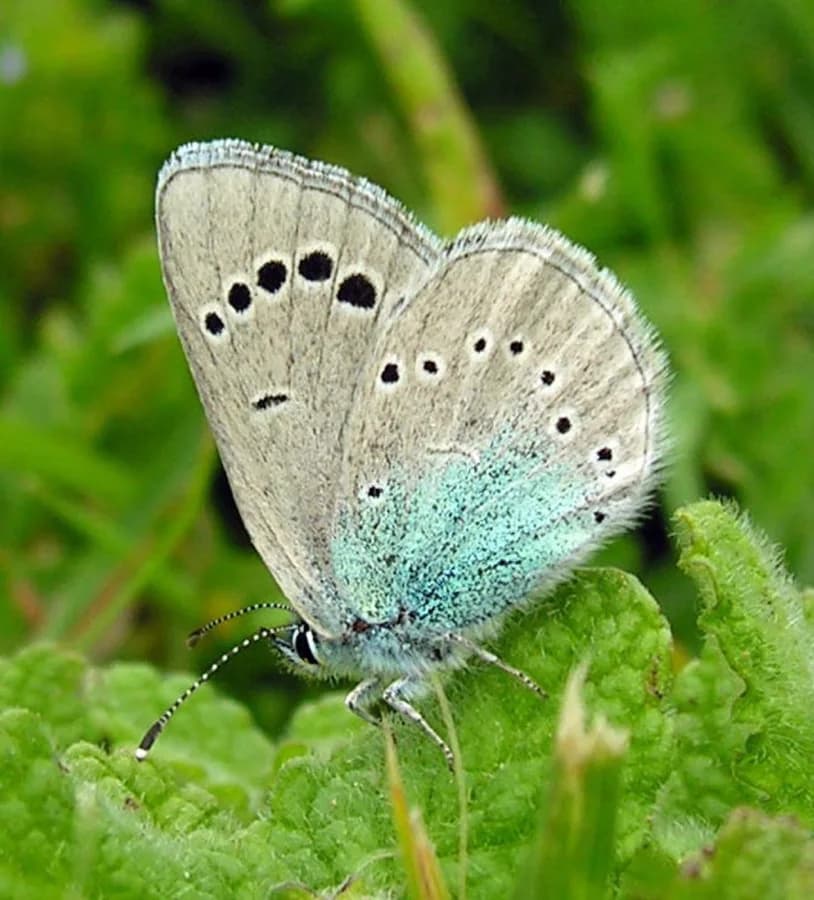
Wingspan 27–36 mm. The male is a brilliant light blue, often with a silvery sheen and sharp black veins. The female has brown-black wings, which are predominantly blue in the center and towards the base. The underside is light grey-white, with strongly spread greenish-blue pigment on the hindwing; the pattern is sparse, with larger, white-ringed black spots on the forewing and fewer, small spots on the hindwing.
Similar species
No similar species are described in the sources consulted.
Distribution
In Scandinavia, two centers of distribution: southeast Norway and Western Sweden up to Värmland, along with eastern Götaland and Svealand, with findings from Skåne to Jämtland and Ångermanland; they are currently merging. The global distribution extends from Algeria through Europe, Turkey, the Middle East, the Caucasus, and Siberia to Trans-Baikal, Mongolia, and northern China.
Biology
The host plants are incompletely known, but likely include several legumes; oviposition has been observed on Astragalus glycyphyllos, and bird's-foot trefoil is a probable host plant. Eggs are laid in flowers or on flower buds, and hatch after a week. The larva feeds on flowers and fruit tissues, and is frequently attended by ants. The pupa overwinters under moss and stones. The species has only one generation per year throughout Europe.