
Identifying features
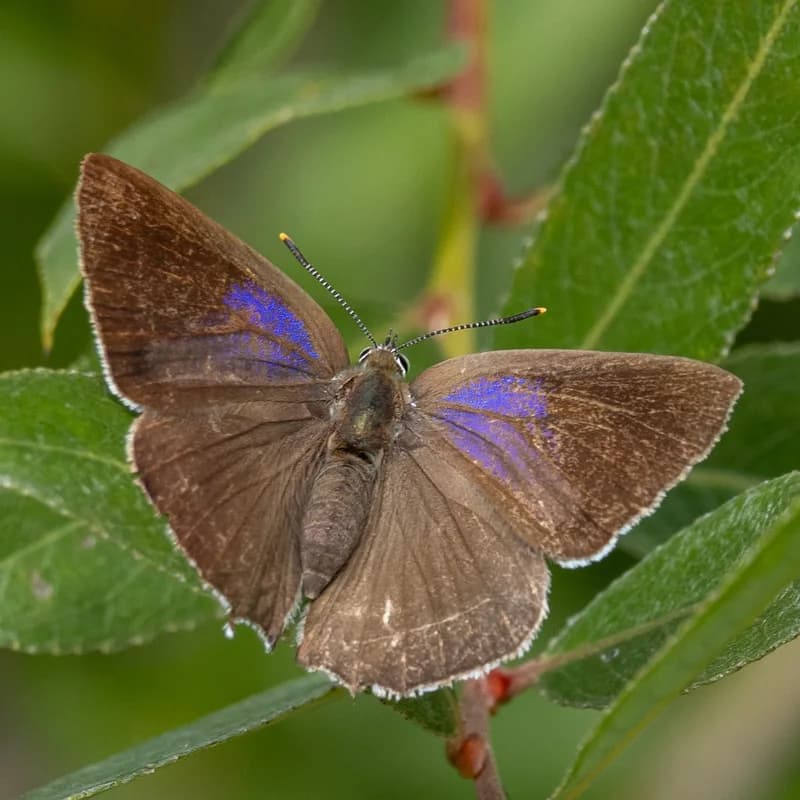
Wingspan 27–34 mm. The male is dark brown on the upper side, with closely-set, iridescent blue-violet scales that shimmer only in a specific lighting angle, and with black spots. The female is dark brown with a large, iridescent violet spot from the wing base on the forewing. Both sexes have short tail extensions on the hindwings. The underside is light grey with a narrow white band and two red-yellow spots on the hindwing, the upper one with a black center.
Similar species
No similar species are described in the sources consulted.
Distribution
Within Sweden, widespread throughout the entire natural range of oak, from Skåne to southern Värmland, southern and eastern Västmanland, the southeasternmost Dalarna, and southern Gästrikland. Also within southern Norway, southern Finland and throughout Denmark. The global distribution includes Europe, Turkey, and Armenia, with an eastern boundary in southern Ural.
Biology
The larvae live on oak and birch, and overwinter in the egg as a fully formed larva; they hatch just before the buds of the oaks begin to open, and initially feed inside the swelling buds, and later at night. Larval development takes 5–10 weeks, and pupation occurs in the outer layer. The males gather in specific locations for mating rituals, preferably on oak trees with honeydew, and rarely descend to ground level. The butterflies are sometimes active until sunset, and at night they can be attracted to UV light.