
Identifying features
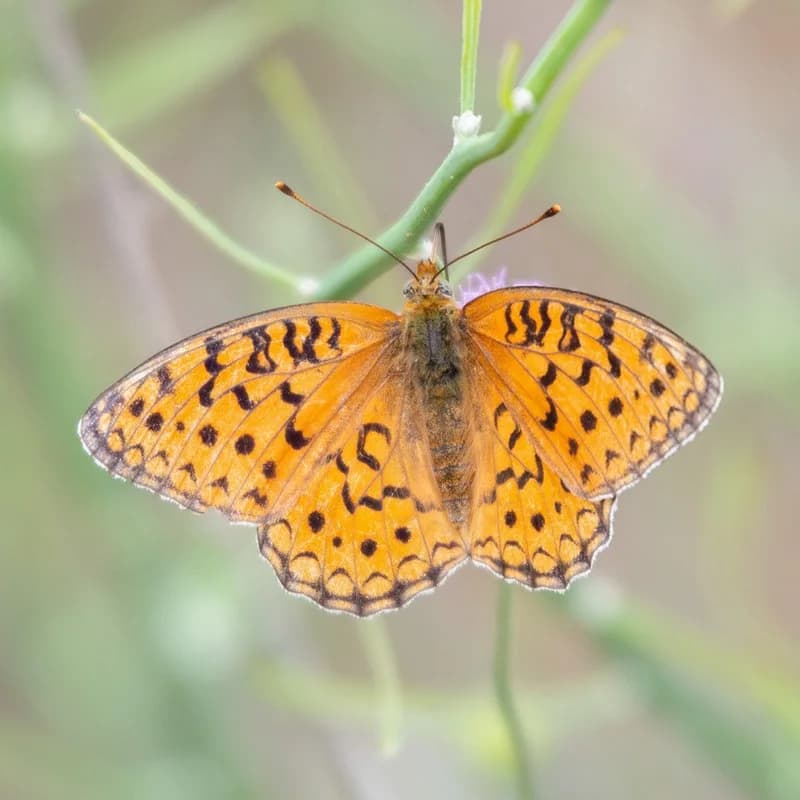
Wingspan 41–52 mm. The male’s upper side is yellowish-red with black spots and usually lacks the scent scales that typically create black markings along the wing veins of High brown fritillary. The female is brownish-yellow with a less sharply defined pattern, often with darker dusting near the wing base. In Sweden, the form with predominantly yellow pearl-like spots on the underside is most common, while the form with silver spots is slightly rarer; both forms are typically found together.
Similar species
Very similar to High brown fritillary (Fabriciana adippe); the Swedish form without silver spots on the underside resembles the form of High brown fritillary. See the characteristics under High brown fritillary for accurate determination.
Distribution
Has decreased significantly over a long period of years; common in the southern and central Sweden during the late 1800s. The distribution extends from North Africa and Spain through Central Europe, Russia, and Siberia to Mongolia; absent in Great Britain and northern France, nationally extinct in Belgium.
Biology
The overwintering occurs as a fully developed larva within the egg. The nocturnal larva primarily feeds on meadow violets; other mentioned host plants include sand violets, sweet violet, and bush violet. Larval development takes approximately 47–60 days. Pupation occurs near the ground surface, within entangled plant material, and the pupal stage lasts approximately 2–4 weeks. The butterfly is an active flower visitor. The species forms more distinctly defined, individual populations within limited areas compared to the closely related, larger fritillary butterfly species.