
Identifying features
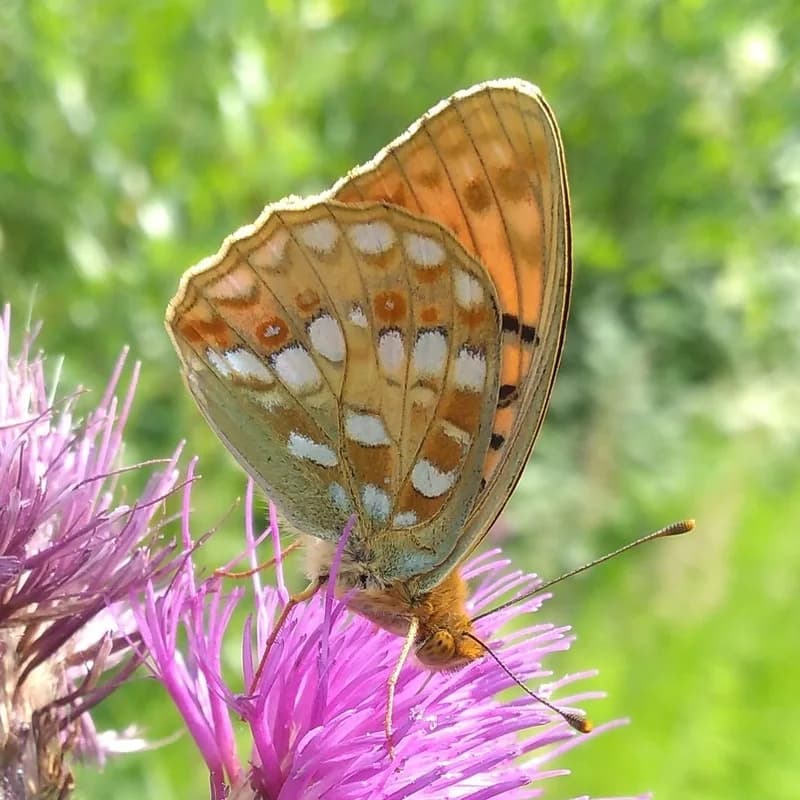
Wingspan 51–63 mm. The male’s upper side is yellowish-red with black spots and scent scales on the wing veins; the female often has a more brownish-yellow shade. The underside of the hindwing is yellowish-green with 14–16 angular silver spots, outside of which are four brown eye spots, usually with a clear silver center. The rare form, cleodoxa, has yellow instead of silver spots on the underside.
Similar species
Very similar to Niobe fritillary (Fabriciana niobe), but High brown fritillary is larger, has five round spots in the outer field of the forewing (not six as with Niobe fritillary), and the fourth silver spot from above in the cross-band of the hindwing is significantly smaller than those above and below.
Distribution
Occurs throughout Northern Europe up to 62°N, except along Norway’s west coast and in mountainous areas; beyond this, only scattered finds indicate temporary migration. In Europe, it is absent only in Ireland, Scotland, and on the more isolated islands of the Atlantic. The global distribution extends from North Africa through Europe and Siberia to the Kuril Islands, Japan, China, and northern India.
Biology
The eggs are laid in pairs on decaying plant matter, stones, and twigs near areas exposed to sunlight, where populations of violets grow. The fully formed larva overwinters in its eggshell and emerges in April. The host plants are several violet species: bush violet, scented violet, woodland violet, forest violet, star violet, and meadow violet. The larvae grow over a period of 7–14 weeks and undergo pupation in a sheltered space made of folded herb leaves; the pupal stage lasts 2–4 weeks. The butterflies are often seen near thistle patches along the edges of ditches and on disturbed ground. The species is temporarily favoured by forest clearing, but declines as grasses take over the cleared ground.