
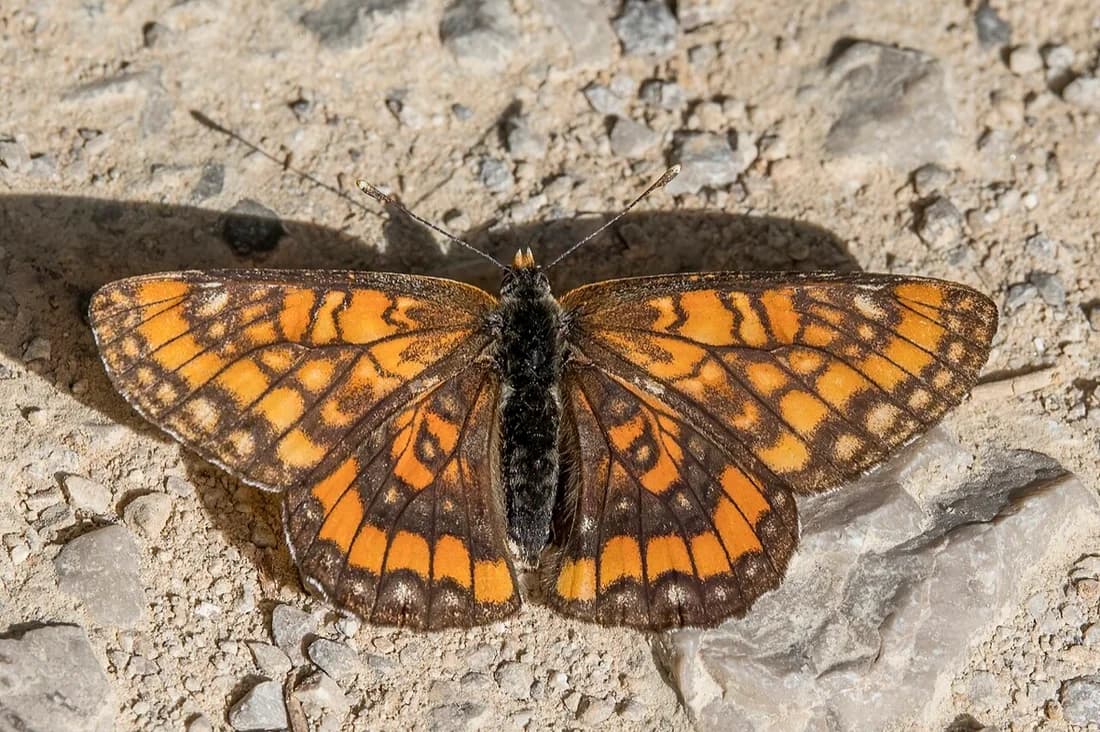
Identifying features
Wingspan 38–46 mm; the male is smaller with pointed wings. The Swedish form has dark brown upper sides with broad, light brown bands in the outer field, two light brown spots in the forewing disc, and a crescent-shaped light brown spot around the disc of the hindwing. The underside is sharply red-yellow with two white bands, a white disc spot, and white edged spots, which on the hindwing are broad and distinctly separated by fine black lines.
Similar species
No similar species are described in the sources consulted.
Distribution
Previously widespread in Scania, Blekinge, and in a belt through central Sweden from Närke to Uppland and Dalarna; today only in two areas, in southwest Västmanland and eastern Uppland. In Finland, in the southern and eastern parts, up to 64°N. The worldwide distribution extends from northeastern France through Central Europe, the Baltic, and Siberia to Altaj and Mongolia; absent from Belgium and Luxembourg, significantly declining in western Europe.
Biology
The host plants are ash and oleander. The female lays up to 250 eggs in a large group on the underside of a sunlit leaf. The newly hatched larvae spin leaves together to form a protective shelter and overwinter in the 3rd–4th instar. In the spring, the larvae initially feed on hawthorn buds, rose hips, and buds of oleander and fly honeysuckle, before switching to swelling birch buds. In Westmanland, the life cycle is primarily 2–4 years, in Uppland and Finland it is 1–2 years. The larvae are attacked by the bracket beetle Cotesia acuminata. The species is threatened by deforestation, heavy deer browsing on ash and oleander, and birch canker.