
Identifying features
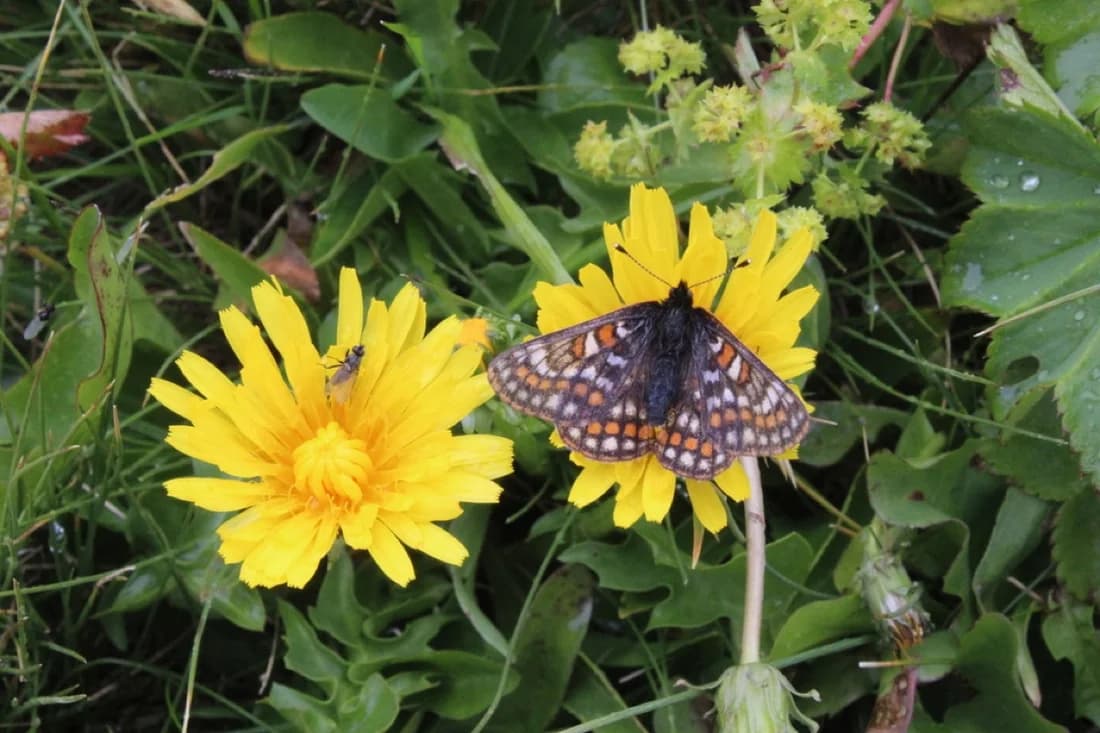
Wingspan 30–42 mm; the female is larger with more rounded forewings. The upper side of the wings is black, with yellow-white and brown-red spots, overlaid by darker wing veins, creating a net-like pattern. The light colour varies from sulphur yellow to white. The brown-red spots vary less in distribution, even on the underside, which gives the species its characteristic appearance. The underside has thinner black markings and more brown-red spots on the hindwing than the upper side.
Similar species
The older larva can be easily confused with that of the barred hairstail (Zygaena exulans) at a distance. There are no similar species that can be confused with the adult butterfly, according to the sources examined.
Distribution
Known from most mountain ranges in relatively humid areas north of 66°N in Sweden, Norway, and Finland, as well as on the Arctic Ocean. In Sweden, from the mountains west of Hornavan, northwards; in Finnmark and on the Arctic Ocean down to sea level. Worldwide: a few isolated populations in central Siberia (Ural, Jenisej, Tajmyr, Jakutien, Magadan), as well as other subspecies in the Caucasus, Sayan, and Altai at altitudes of 1800–2700 metres. The species is listed as strongly threatened in Europe and within the EU.
Biology
The early stages of development are poorly known. The larvae likely live socially until overwintering. Older, solitary larvae have gathered on blackthorn and willow, feeding primarily on flowers and shoot tips. The larvae prefer to pupate on the sun-exposed side of rocks. The life cycle is likely multi-annual, with at least 2–3 overwinterings. The butterflies are typically slow fliers, often landing with their wings spread on the ground. Population size varies greatly from year to year, from massive appearances to very infrequent occurrences over long periods.