
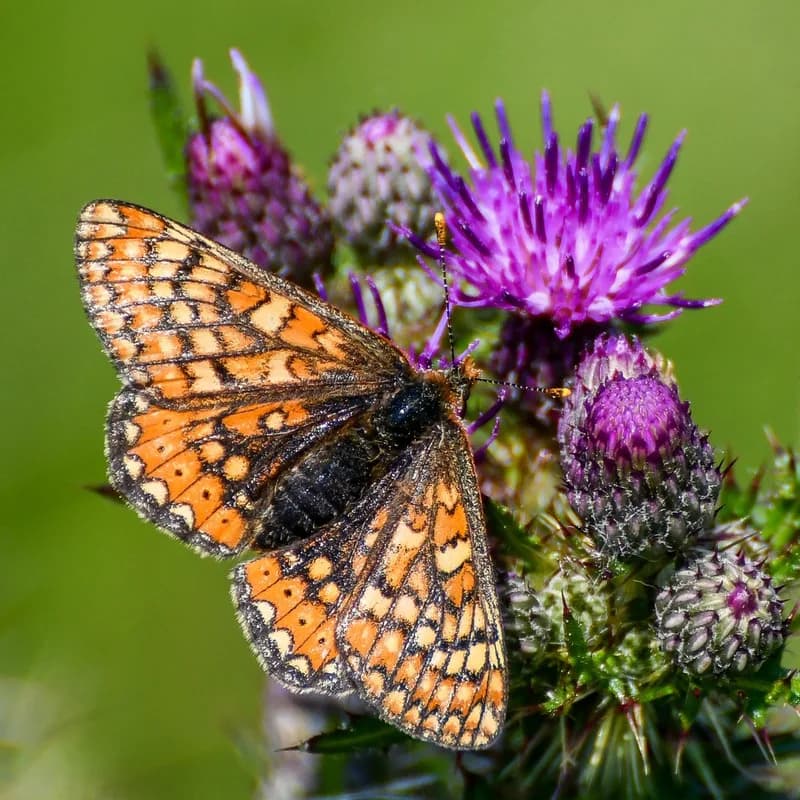
Identifying features
Wingspan 33–46 mm; the female is noticeably larger and more rounded. The upper side of the wings is brown-black with broad, pale yellow bands; on the hindwing, each cell in the outer field has a distinct black spot – the most recognisable feature in the field. The underside of the hindwing is pale ochre to light yellow, with the black spots surrounded by a lighter ring. The species varies considerably individually and geographically; on Gotland, lighter, ochre females are often found.
Similar species
No similar species are described in the sources consulted.
Distribution
In Sweden it was formerly known from Skåne to Medelpad. Today it remains on Öland and Gotland, with a more continuous distribution through central Sweden from southwestern Västmanland to northern Uppland, southern and central Dalarna, and southern Gästrikland. It has declined sharply in Finland and Denmark. Its world distribution extends from North Africa and the Nordic countries eastwards through Europe and Siberia to Mongolia, northern China and Korea.
Biology
The host plant is devil’s-bit scabious. The female lays 50–200 eggs in groups on the underside of a sun-exposed leaf. The larvae spin a protective covering, live socially, and overwinter in the 3rd–4th instar within a dense, small sac. In spring, they become active immediately after snowmelt and pupate while suspended on dry plant parts; the pupal stage lasts 2–3 weeks. The larvae are attacked by the parasitoid wasp Cotesia melitaearum. The butterflies exhibit local fidelity; the males patrol in search of newly emerged females.