
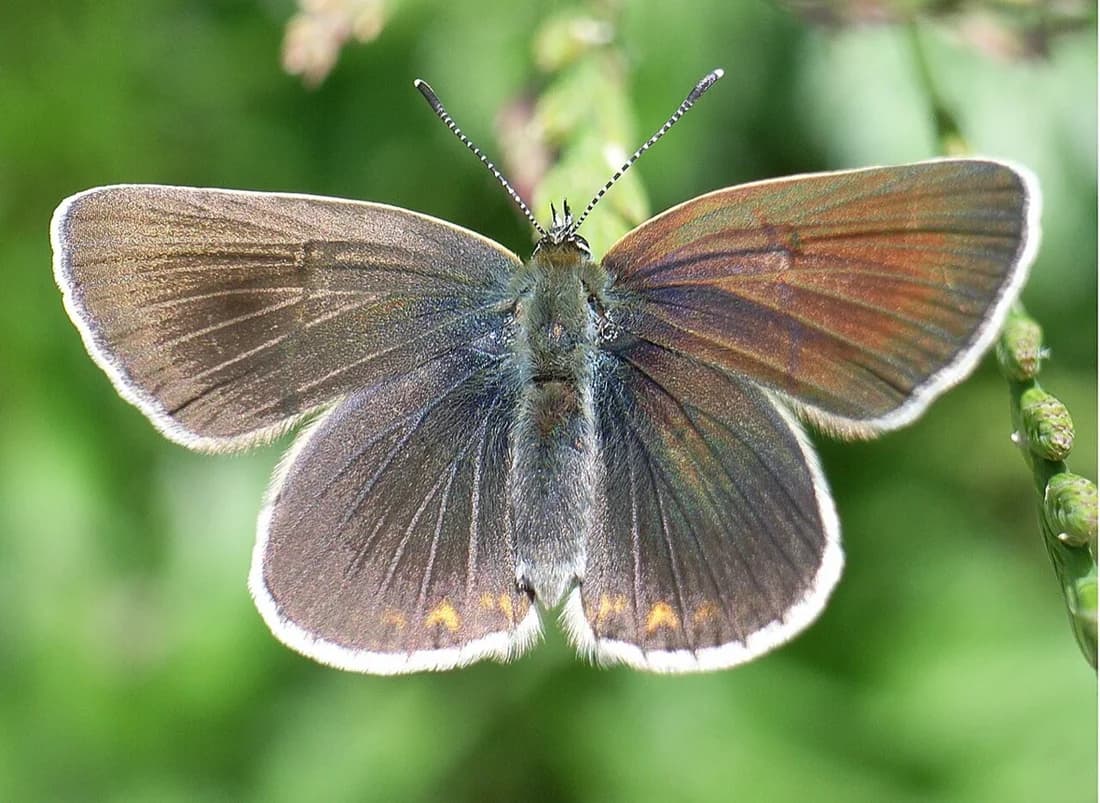
Identifying features
Wingspan 24–27 (–32) mm. Both sexes are dark brown on the upper side; the female sometimes has some reddish-yellow margins on the hindwings. The evenly broad, lighter line from the disc spot to the hindwing spots on the underside distinguishes it from other dark blue hairstreaks, and the spread blue-green scales on the inner part of the hindwing underside distinguish it from other Aricia species.
Similar species
The female of Silvery argus (Aricia nicias) resembles Geranium argus, but on the underside of the hindwing, the white wedge in Geranium argus extends only to the discal spot, while in Silvery argus it reaches beyond it.
Distribution
Continuous distribution area in Sweden, from northern Värmland, Västmanland, and the archipelago of Södermanland, to Jämtland, southern Lapland, and Tornedal, as well as isolated locations near Lake Vänern, Lake Vättern, in southeastern Scania, on Öland and Gotland. Absent in Denmark. The global distribution extends from the mountain ranges in Spain and Italy, through eastern France, Germany, and Poland, to Northern Europe and further through Turkey, Russia, and Siberia, to Kamchatka and northern China.
Biology
The host plants are bloody cranesbill (Geranium sanguineum) and skogsnäva (G. sylvaticum). The female lays one egg, and a new larva is preyed upon by a rodent on bloody cranesbill. The larva feeds for only two weeks before preparing for overwintering in the third instar, and is actively attended to by ants. The species only produces one generation per season.