
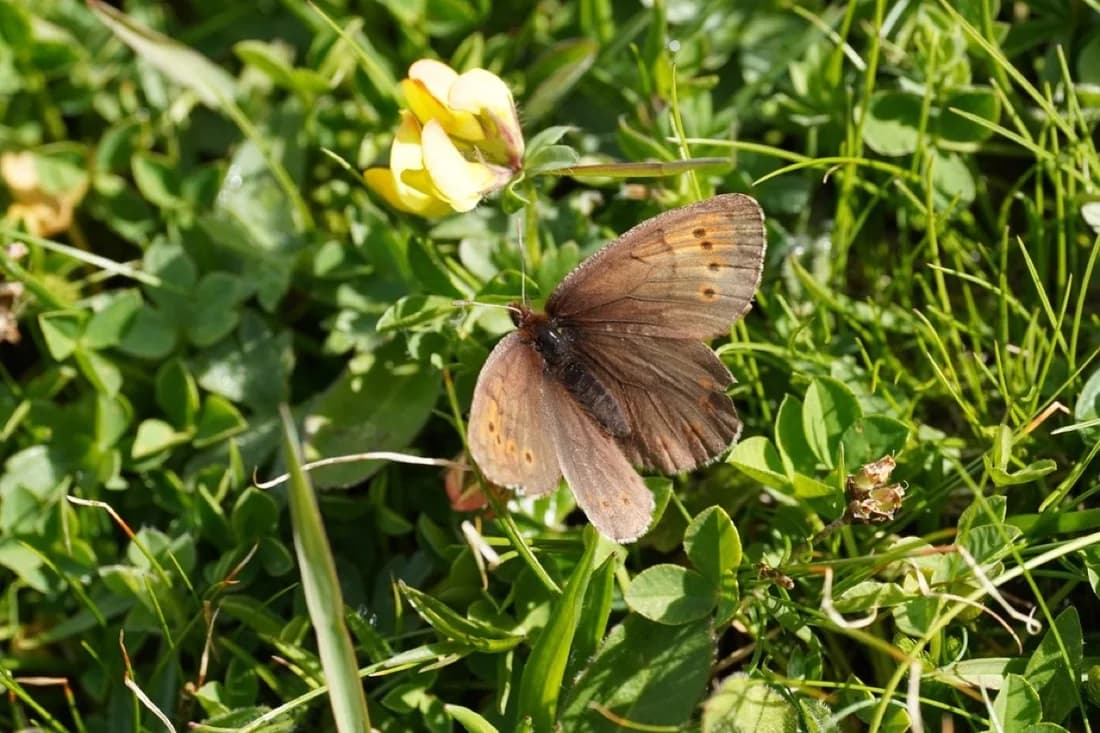
Identifying features
Wingspan 31–50 mm and the sexes are similar. The upper side of the wings is dark brown, sometimes slightly lighter grey-brown. The forewing has a broad, brownish-red transverse band with 3–4 small eye spots, while the hindwing may or may not have 1–4 eye spots with reddish-brown rings. The underside of the hindwing is finely mottled in ash grey or brown with a wavy, black-edged central band. The species varies geographically: largest and most marked in the southwest, smallest and most uniform furthest north.
Similar species
No similar species are described in the sources consulted.
Distribution
Found throughout the entire mountain range; in Sweden from the southernmost mountains in Dalarna to Treriksröset, north of the Arctic Circle, and also below the mountains. In Norway from southern Agder to North Cape. Elsewhere in the world: isolated mountain populations in the Pyrenees, Alps, Carpathians, central Italy, and southern Balkans, as well as from Scandinavia to the Kola Peninsula, and in Asia from the Altai region to northern Mongolia.
Biology
The butterflies are active in sunny weather from early morning and mainly visit flowers during the morning. Males patrol their habitat in search of receptive females, and mating takes place on the ground. Eggs are laid singly and scattered. The larvae feed on grasses. In northern Norway they have been found beside sheep’s fescue, thought to be one of the host plants; older literature also mentions meadow-grasses and fescues. The species is more tolerant of deep snow cover than most other butterflies.