
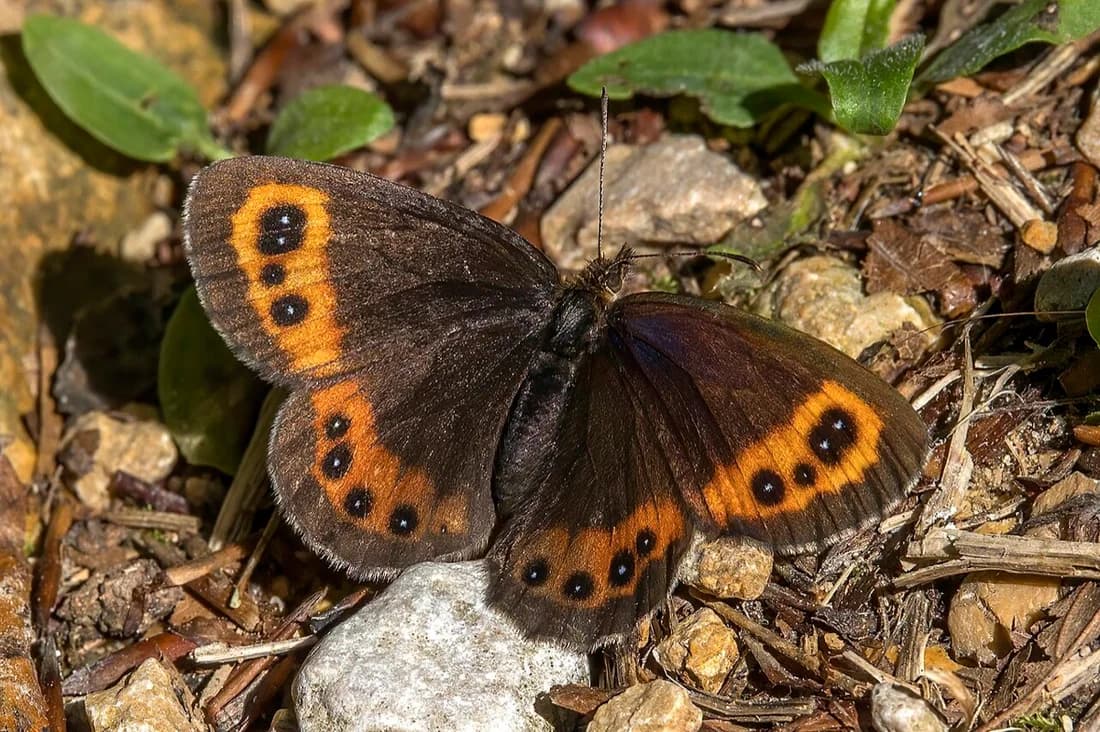
Identifying features
Wingspan 36–48 mm; the sexes are alike. The wing uppersides are blackish-brown to dark chocolate-brown, with white-spotted fringes and a brick-red transverse band on both wing pairs enclosing rows of black eyespots. The 3–4 forewing eyespots have white centres and are usually larger than the three on the hindwing. The hindwing underside has a white transverse band inside the eyespots, which here are surrounded only by rust-red rings.
Similar species
No similar species are described in the sources consulted.
Distribution
Occurs throughout Sweden, except in Scania and on Öland and Gotland; very sparse in the northern coniferous taiga between the mountain range and the Bottenhav coast. Found in Norway and Finland, extending to northern Finnmark and Lapland. The global distribution extends from European mountain ranges and Fennoscandia through Russia and Siberia to Kamchatka, Japan, and Korea.
Biology
The female lays eggs individually, scattered on grasses, where the eggs overwinter. The larva emerges in April–May and grows very slowly; it overwinters in its fourth instar and does not pupate until the following year. Older literature mentions only Milium effusum as a host plant, while more recent information also indicates, among others, Potentilla anserina, Hieracium species, Deschampsia flexuosa, Littorella uniflora, Scirpus species, Festuca rubra, and Poa pratensis. Male butterflies congregate along nectar-rich areas along forest roads, where courtship and mating occur. The species is more common in southern Sweden, particularly during odd-numbered years.