
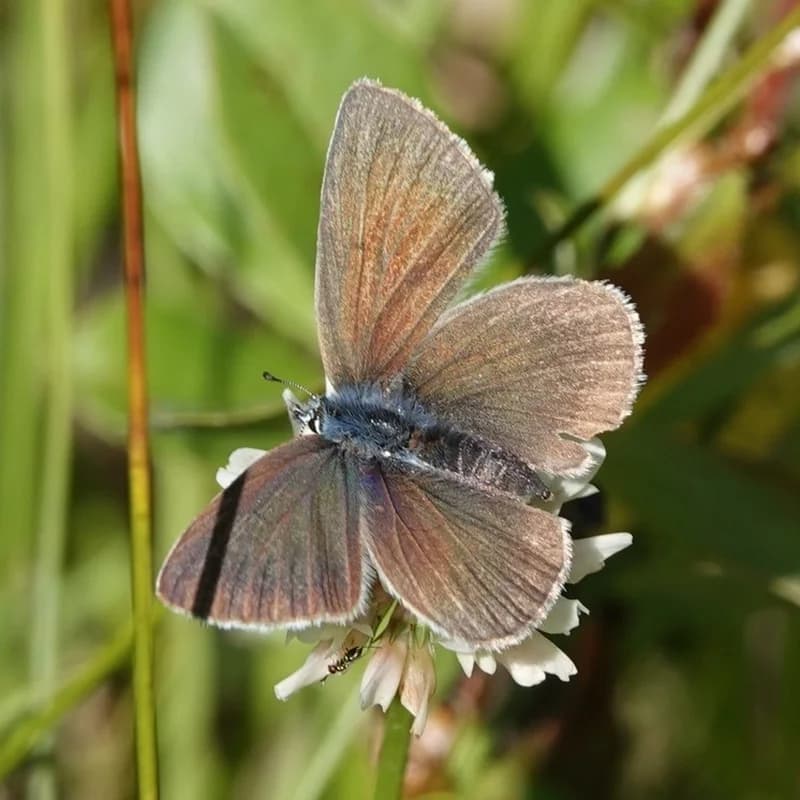
Identifying features
Wingspan 24–34 mm. The male’s upper side is dark violet-blue with a broad black spot, and usually black dusting on the wing veins near the outer edge. The female is uniformly brown. The underside is ash grey to brown-grey, with green-blue scales near the wing base, distinct white-ringed black spots, and clear, narrow disc markings.
Similar species
The Honan could be confused with small blue (Cupido minimus), but Mazarine blue is always larger. With Green-underside Blue (Glaucopsyche alexis), the spots on the underside of the forewing are larger than those on the hindwing, whereas with Mazarine blue, they are equally sized.
Distribution
Found throughout all of Northern Europe, with a northern boundary in the inner southern Nordland (Norway) and upper Tornedal (Sweden) in Finland; it follows the cultural regions upwards into the mountain valleys up to Jämtland. Its global distribution extends from North Africa and Spain, through Europe and Siberia, to northern China and Korea.
Biology
The larvae feed on flowers and fruit tissue of peas, in Sweden primarily red clover. The eggs are laid one at a time in the flower crown, and development is rapid. The species only appears with one generation per year in Sweden; the larva overwinters in its third stage. The larvae are actively courted by ants. The males patrol and observe stationary in their search for a mate.