
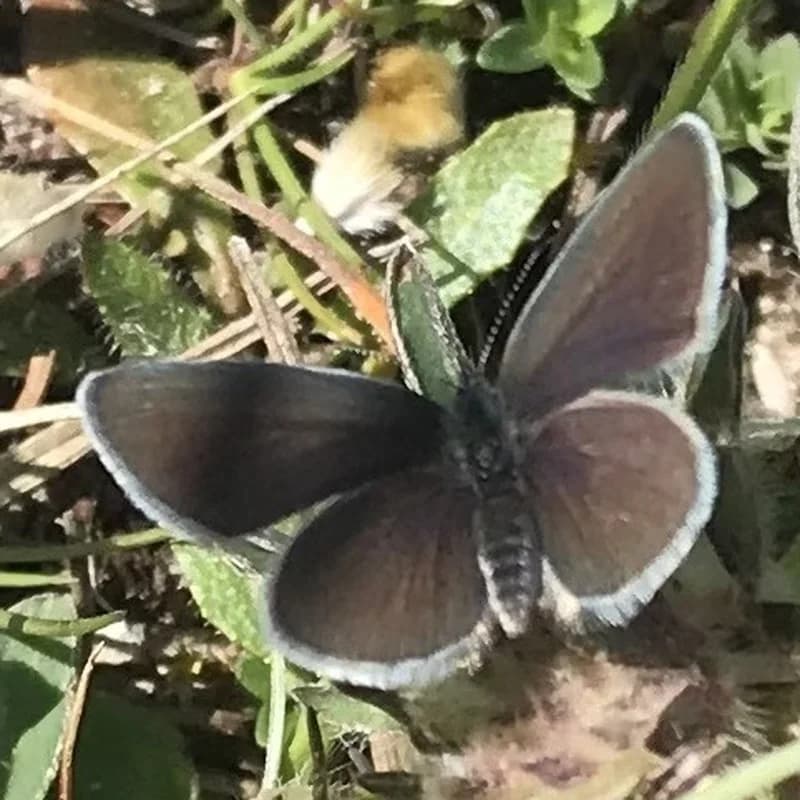
Identifying features
Wingspan 18–25 mm. The males are similar; the males have sparsely distributed bluish wing scales on the otherwise brown upper sides, primarily near the wing base. The underside is light grey with fine dark grey spots and lacks entirely yellow spots.
Similar species
The species can hardly be confused with any other, but it resembles something like the female of the larger species Mazarine blue (Cyaniris semiargus).
Distribution
In Sweden it is more widespread on Öland and Gotland; elsewhere there are only a few areas of occurrence in each province, from southern Sweden to Norrbotten and in the mountains. It also occurs in Denmark, Norway and Finland. Its world distribution extends from Spain to Turkey and the Caucasus, then through Siberia and northern China to Kamchatka and Korea.
Biology
The main host plant is kidney vetch (Anthyllis vulneraria); on Öland Oxytropis campestris is also used. Eggs are laid in the flowers, where the larvae feed on flowers and developing ovaries. Larval development takes just 3–4 weeks. The larvae spend the rest of the summer in diapause and overwinter fully grown. The species remains close to its breeding sites and can occur at high densities in small areas.