
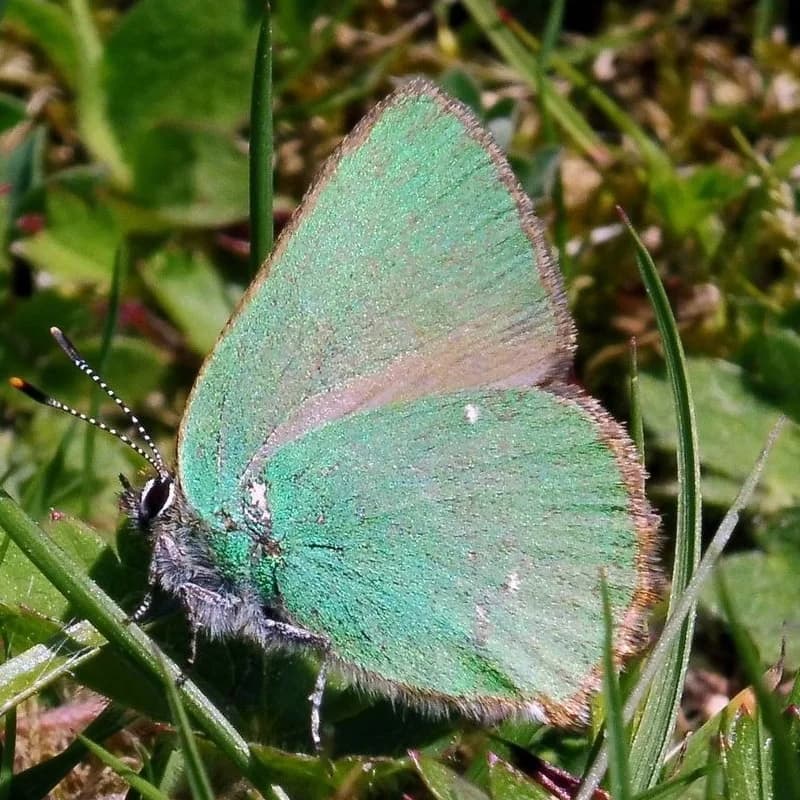
Identifying features
Wingspan 23–25 mm. The sexes are alike. The upper side is uniformly grey-brown; the underside is uniformly emerald green, usually without markings except for a small white spot at the front edge of the hindwing. The hindwings end with a short, hooked edge. When resting in sunlight, it often rubs its wings together.
Similar species
No similar species are described in the sources consulted.
Distribution
Widespread and common throughout all of Scandinavia, more local and sparse in relation to the mountain ranges and north of the Arctic Circle; also a permanent resident on Gotska Sandön. The global distribution extends from North Africa and Ireland through Europe and Siberia to Tian Shan, Mongolia, the Amu region, Magadan, and Kamchatka.
Biology
The larvae feed on flowers and fruits of a variety of host plants, primarily bilberry, bog bilberry, lingonberry, and cranberry in Northern Europe. The eggs are laid one at a time, or near flower buds, and development takes approximately one month. The pupation stage occurs in moss in dry habitats, or on plant stems in damp areas; overwintering takes place in the pupal stage. The males establish small territories in sun-exposed clearings.