
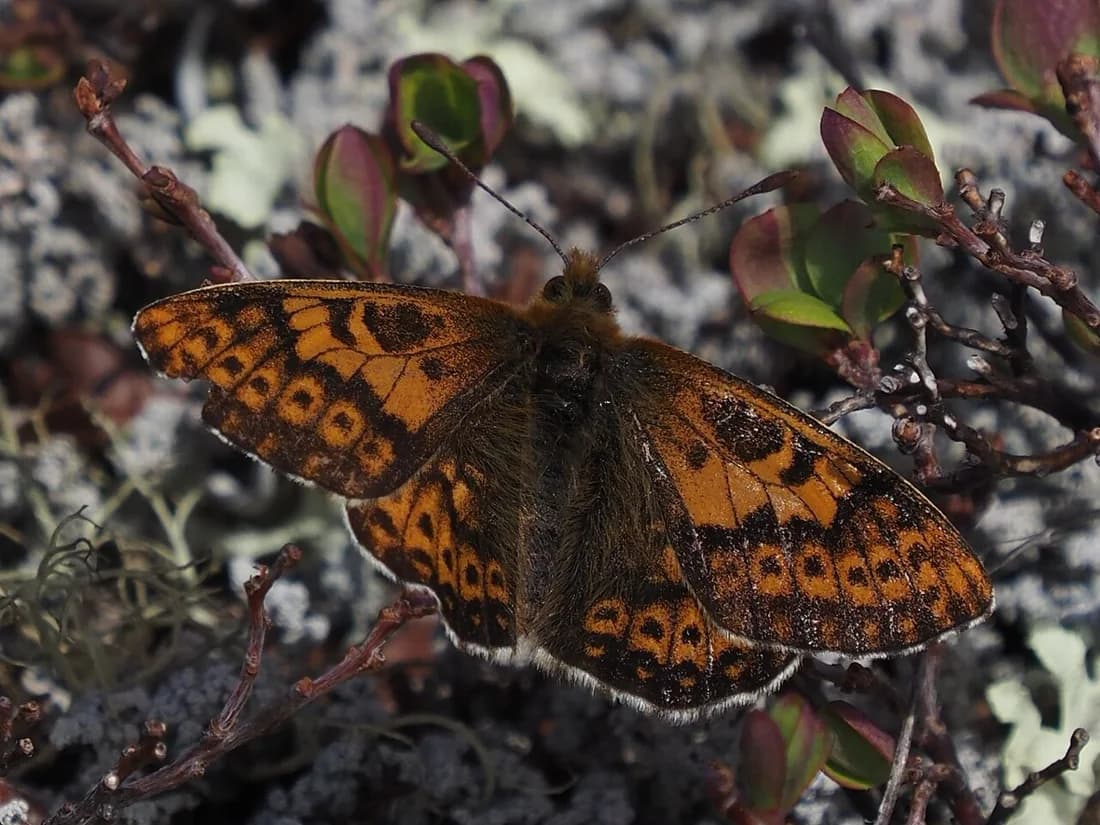
Identifying features
Wingspan 34–43 millimetres. The underside of the hindwing is reddish-brown with a white, irregular, and black-edged band, as well as T-shaped white spots that are bordered inwards by triangular, dark brown spots. These T-shaped spots are the species’ most prominent characteristic.
Similar species
Closest to being confused with Freija Fritillary (Boloria freija) and Purplish Fritillary (Boloria chariclea); the T-shaped white edge markings distinguish the species from both.
Distribution
Sweden is known only from two smaller mountain ranges within the mountain region north of Torneträsk; otherwise, it has a circumpolar distribution throughout arctic Asia, North America, and Greenland.
Biology
The developmental stages are poorly known in Sweden; the life cycle is thought to take at least two years. Mountain avens has been proposed as a host plant.