
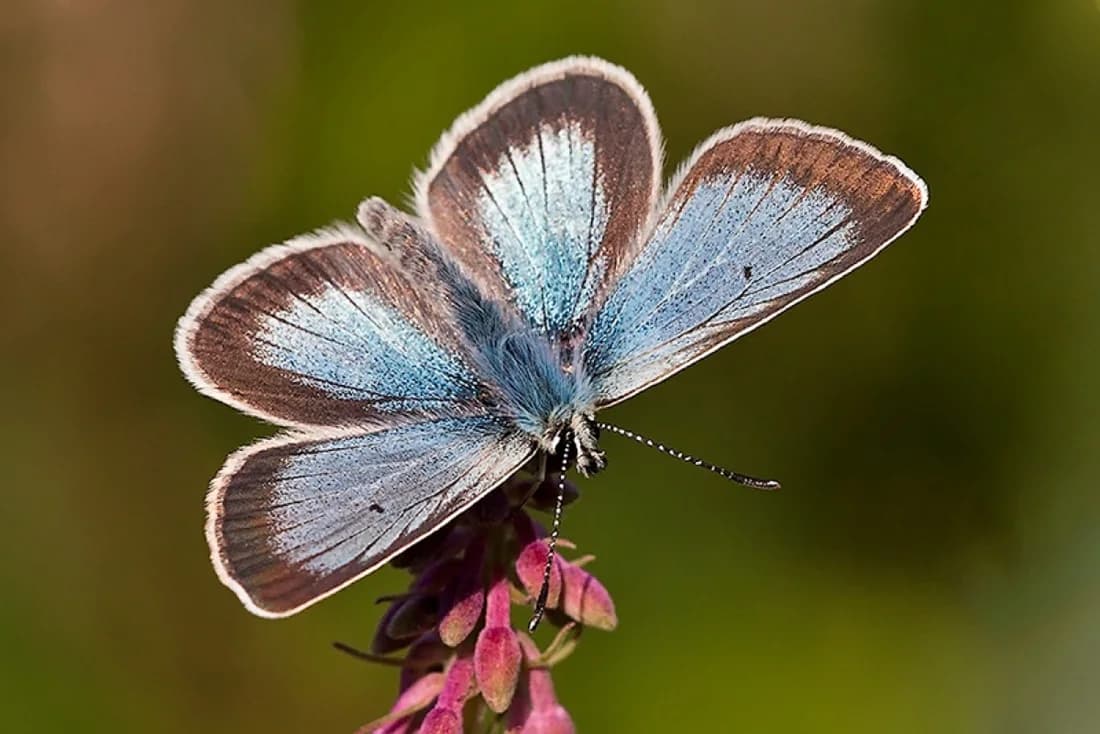
Identifying features
Wingspan 25–28 mm. The male's upperside is light green-blue with sharply defined, broad dark brown marginal borders. The female is brown with a small amount of blue pigment closest to the base. The underside is light grey to yellowish-grey, with small, indistinct dark spots and border markings. A long, wedge-shaped white streak runs through the centre of the hindwing underside, with a tip that extends past the disc cell.
Similar species
The spot resembles Geranium argus (Eumedonia eumedon), but with Silvery argus, the white spot on the underside of the hindwing extends beyond the discal spot, whereas with Geranium argus, it only reaches up to it.
Distribution
In Sweden, from northernmost Västmanland and Uppland through Dalarna and all of the forested lowlands and coastal districts of Norrland to Norrbotten and Lycksele lappmark; absent from Värmland and Norway. Its world distribution consists of isolated areas in the eastern Pyrenees, the Alps, Fennoscandia, the Urals and the Altai.
Biology
The host plant is, in Sweden, primarily Chamerion angustifolium; the female lays eggs on wilting leaves. The species is a frequent visitor to flowers and is found in the most flower-rich areas of meadows. Occurrences are concentrated in river valleys and in the traditional grazing pastures of forested areas, and the species appears to have higher requirements for its habitat than simply a plentiful supply of the host plant.