
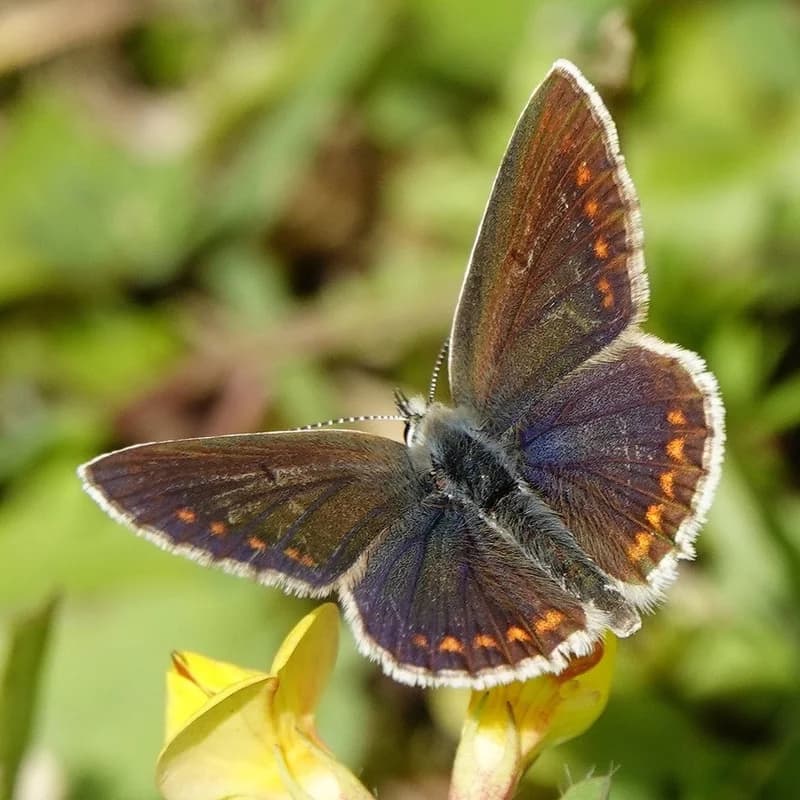
Identifying features
Wingspan 26–31 mm. Both sexes are dark brown on the upper side, always with a hint of yellowish-red borders on the hindwings, and the forewing has a clear black disc spot. The underside is light grey-brown with clear black spots and large red borders on both wing pairs. The male can, in certain lighting, display a greenish-blue shimmer.
Similar species
The very close red-spotted blue-winged bee (Aricia agestis) occurs in Sweden only in Scania and is difficult to distinguish. Larger individuals can be distinguished from Geranium argus (Eumedonia eumedon) on the underside of the hindwing, where the white spot is wider and more triangular than in Geranium argus.
Distribution
Widespread across almost the entire Sweden area; it is only occasionally or more localised in southern and western Götaland and along the coast of the Gulf of Bothnia. It also occurs in large parts of Norway and Finland. The global distribution encompasses primarily mountain ranges from North Africa and Scandinavia through Europe and Siberia to Mongolia, northern China, Korea, the Amur region, and Sakhalin.
Biology
The host plants vary regionally: sun daisies in southern Sweden, bloody cranesbill in central Sweden, and wood violets from Bergslagen. The eggs are laid one at a time on the underside of flower buds and hatch after a week. The larvae overwinter in their third stage and pupate on the underside of a leaf near the ground. The butterflies are strongly tied to their local area, and the males often gather in areas with abundant flowers where unmated females can pass.