
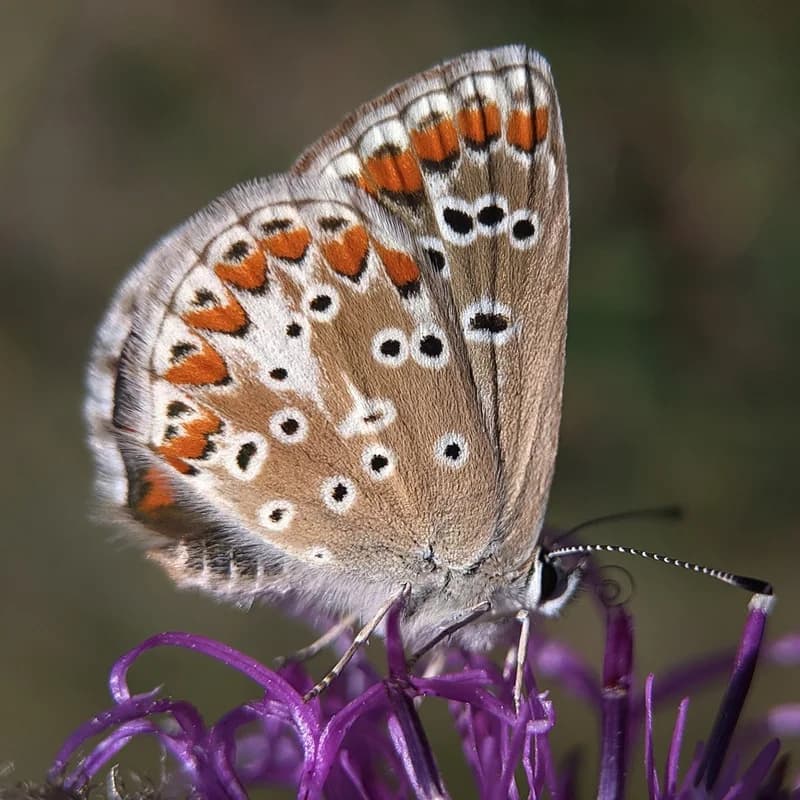
Identifying features
Wingspan 24–28 mm. The males are similar, with orange-red edged spots that are larger and more evenly distributed over both pairs of wings compared to our other blue-winged species with brown males. The undersides have distinctive markings with coarsely black-centred white spots in pearl bands along the outer edge and more or less continuous orange-red spots.
Similar species
No similar species are described in the sources consulted.
Distribution
Within Sweden, limited to Skåne – primarily Österlen and Vombsänkan, with more sporadic occurrences along the west coast to Bjärehalvön – and in western Blekinge during the 2000s. Significantly more widespread in Denmark. The global distribution extends from the Mediterranean and southern England to central Siberia and Altaj.
Biology
The larvae feed on various ant species, including the black ant and the red ant, and have a close relationship with ants, which tend them against sugary secretions. The first generation of larvae develop slowly and overwinter, while the second generation of larvae develop more rapidly in July. The butterflies can be numerous within small areas of flower-rich, open meadows.