
Identifying features
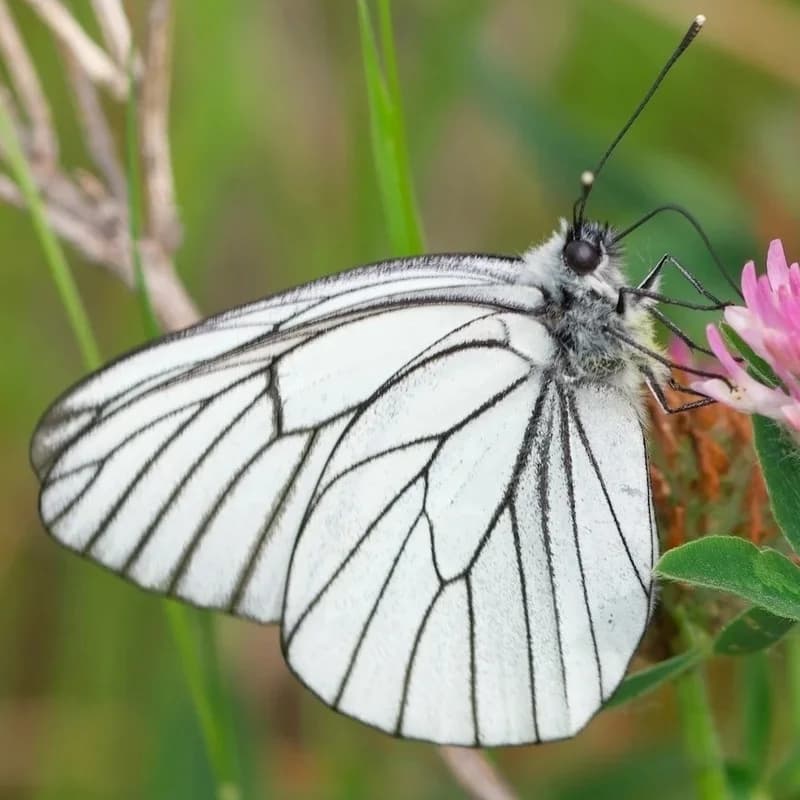
Wingspan 58–77 mm. The wings are white on both sides and thinly scaled, with black wing veins and a narrow black disc spot. The females lose a large proportion of their wing scales during mating, and subsequently appear more translucent. The larva is fully grown, black, with broad lateral longitudinal markings of reddish-brown spots and dense, long light setae.
Similar species
No confusing species are described in the sources examined. The size and the black veins on the white wings are characteristic.
Distribution
Black-veined White has had its strongest populations in Sweden on Öland and Gotland. It remains locally abundant in eastern Småland, Värmland, and Gästrikland, and has very small populations scattered in the rest of Götaland and Svealand. In recent years, with favourable summers, it has spread again, primarily in Småland and Östergötland.
Biology
The butterflies are active flower visitors and often fly long distances to find rich flower meadows. The males patrol through open corridors in search of receptive females.