
Identifying features
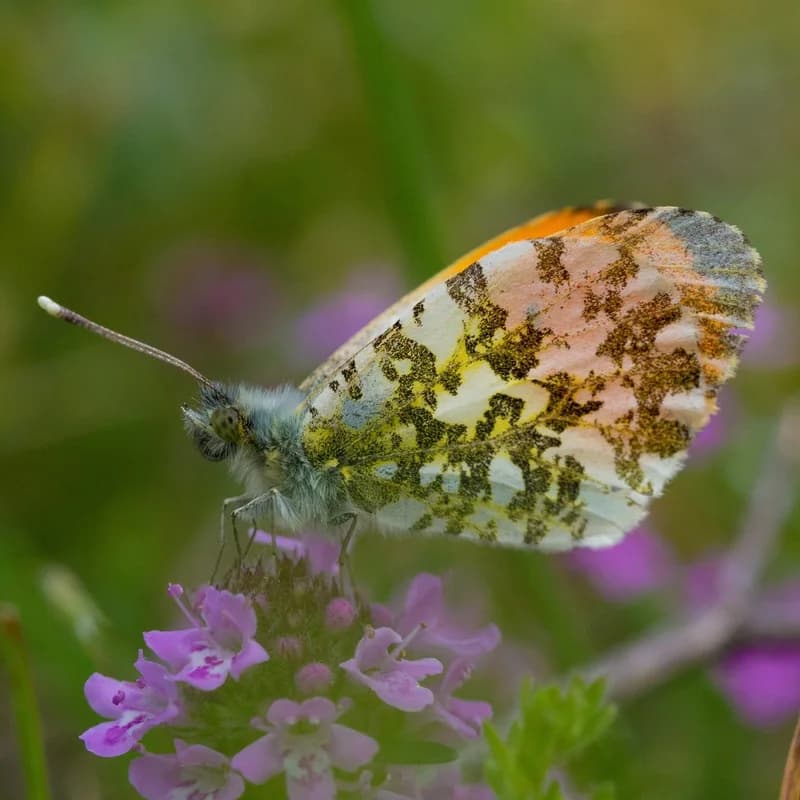
Wingspan 31–50 mm. The forewings are white on the upper side; in males, the outer half of the forewings are orange, from the narrow black pointed spot to within the rounded disc spot. The female lacks the orange colour and has a wider pointed spot and a stronger, crescent-shaped disc spot. The undersides of the hindwings are mottled with green and black, with irregular white spots – an excellent camouflage.
Similar species
No confused species are described in the sources examined. The male’s orange forewing tips are unmistakable; the female can resemble other white white butterflies, but has a marbled green underside.
Distribution
Orange tip is fairly common throughout southern and central Sweden, but rarer in Norrland. It is largely absent in the mountainous regions. Denmark is found in suitable environments throughout the country; in Norway, Nord-Trøndelag forms the northwest boundary.
Biology
Several plants in the aster family can be used as host plants, primarily meadow cranesbill, garlic trap, rock-cent, woodland trap, and thyme. The female lays eggs individually, one at a time, on the buds. Egg and larva development take 5–10 and 16–34 days respectively; the pupa overwinters exposed on decaying herb stems.