
Identifying features
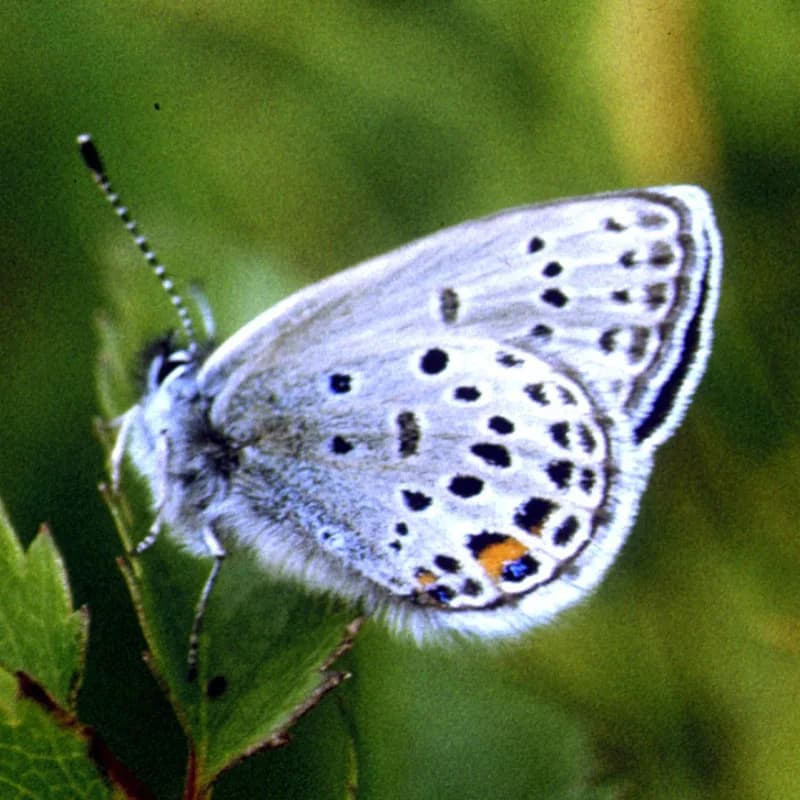
Wingspan 23–29 mm. The male is violet-blue on the upper side, with a narrow, distinct black spot. The female is dark brown to grey-brown, with blue scales near the disc. The underside is light grey with distinct black and white spotted markings. The yellow edging band is restricted to 2–3 cells at the lower part of the hindwing underside, with a particularly large spot in cell CuA2.
Similar species
No similar species are described in the sources consulted.
Distribution
Found throughout the Nordic region except Iceland. In Sweden, it also occurs on dry ground in the north, for example in pine heaths and mountain birch woodland. Globally, its range extends from the Balkans and the Alps through Europe and Siberia to Mongolia, Japan, Kamchatka and the Kuril Islands, and in North America from Alaska to central Canada.
Biology
The larvae live on bog rosemary, cranberry, bog bilberry, and lingonberry, and are not attended to by ants. The eggs are laid one at a time on the undersides of leaves, and hatch after approximately ten days. The larvae overwinter as a firmly attached larva on the underside of evergreen leaves, and pupate in the spring, secured with a thread under a leaf. The males patrol in their search for unmated females.