
Identifying features
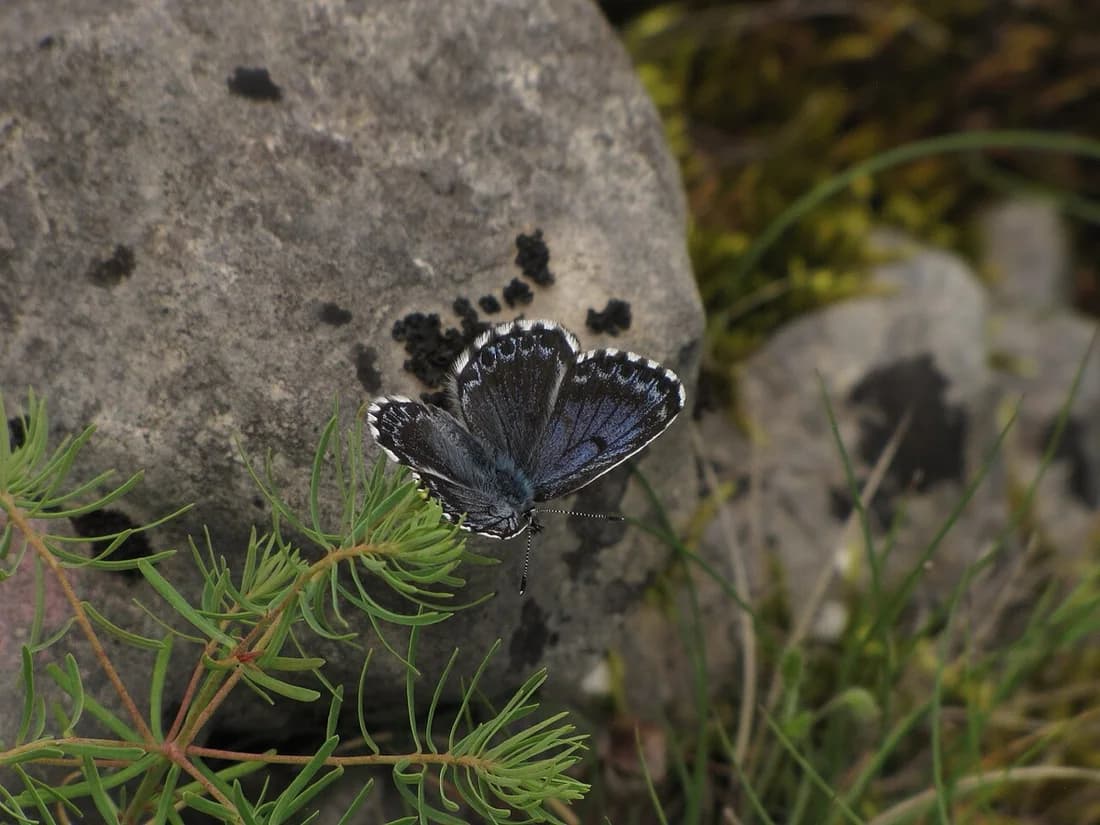
Wingspan 27–32 mm. The wing uppersides are usually clearly bluish in colour, but sometimes browner, with characteristic black spots along the edges. The light grey wing undersides have many black spots and blotches of varying size and shape, and on the hindwing undersides there is also a clear orange band forming a long arc.
Similar species
For someone who is well-acquainted with our blue-winged species, there are no confused species associated with Chequered blue within Norway. A number of blue-winged species fly simultaneously with Chequered blue, as most begin at later dates (as documented).
Distribution
Previously common in a number of locations in rocky terrain, close to the Swedish border, from Halden municipality to Arendal municipality. Since 2012, it is only known from Halden, where, however, the species has a good population distributed over a larger area. Approximately 4,500 sightings. Listed in the Red List as Critically Threatened (CR) and a prioritized species according to the Nature Conservation Act, with its own action plan.
Biology
The larva feeds on orpine. One or more eggs are laid at different places on each plant. The larvae are green and red, well camouflaged on orpine, and frequently visited by ants seeking the sweet secretion the larvae produce. The species overwinters as a pupa. Adults visit several plants for nectar, such as sticky catchfly.