
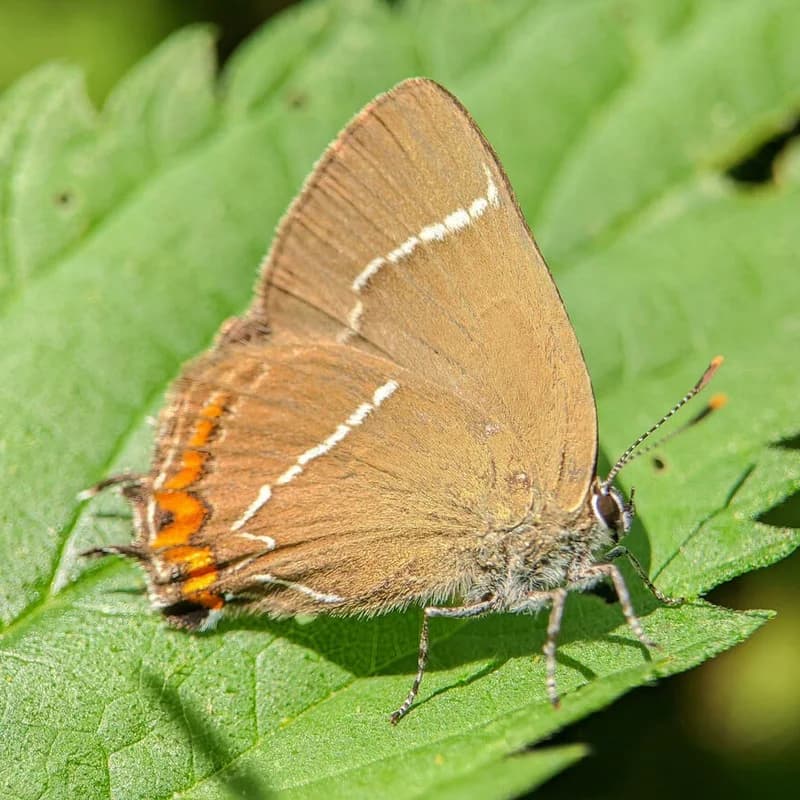
Identifying features
Wingspan 26–32 mm. Both sexes have dark brown to black uppersides; at the rear of the hindwing, there is a small orange spot, and the tail exhibits some white colouration. The undersides are mostly brownish-grey, with a white cross-band across the wings that, on the hindwing, forms a somewhat recognisable "W". The hindwing features several yellow-orange crescent-shaped spots with a dark center, located near the "tail".
Similar species
No confused species are described in the examined sources.
Distribution
Widespread on Southern Norway and the southern part of Eastern Norway; in Agder and Telemark, far inland, with a certain expansion inwards over the last ten years. The northernmost finds are in Hamar. Listed as near threatened (NT); alder blight is the greatest threat since the species is heavily dependent on the larger alder trees.
Biology
The species lives on elm. The eggs hatch early in the spring, before the alders have leaves, and the newly hatched larvae initially feed on alder flower buds; the species is therefore dependent on larger elm trees that bear flowers. The larva feeds on both young leaves and bracts. The species flies high, often in the treetops, and rarely visits meadows with wildflowers.