
Identifying features
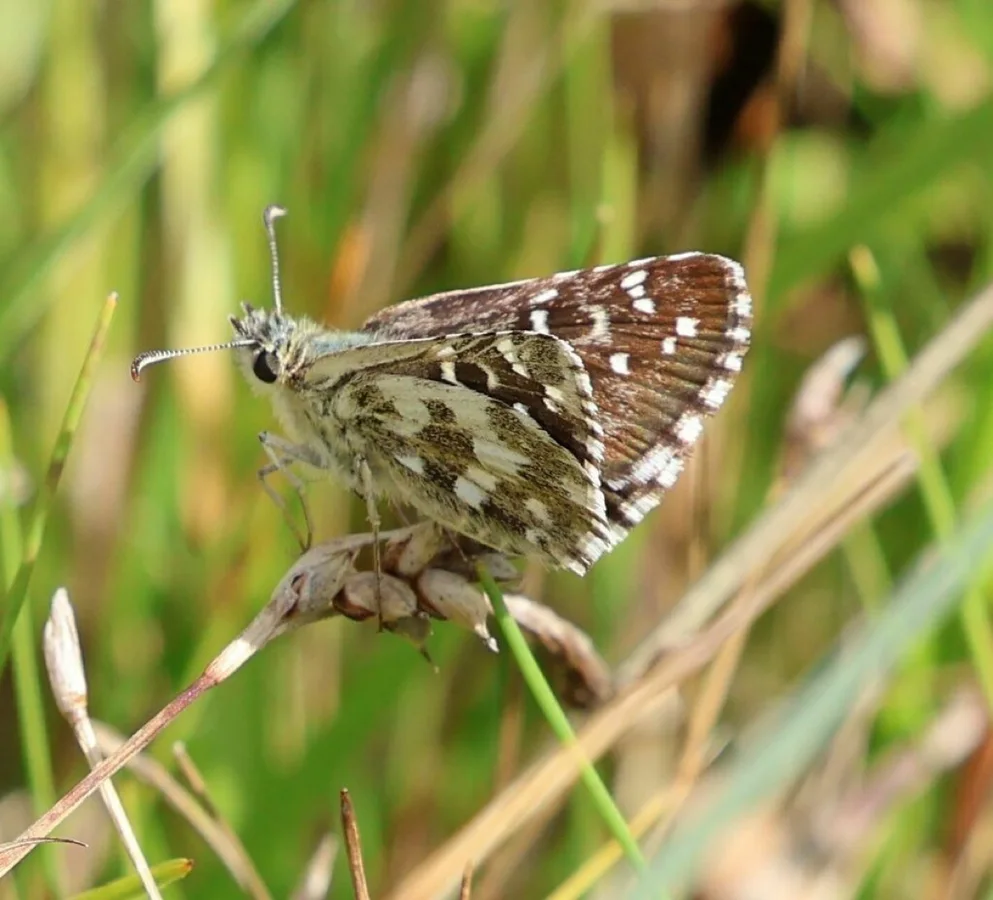
Wingspan 26–29 mm. The wings’ base colour is dark brown-grey. The forewing’s white spots are small, but clear, while the hindwing has only faint indications of light markings. The large white spot in the center of the underside of the hindwing is sharply cut off inwards.
Similar species
Differentiates from Northern grizzled skipper and Grizzled skipper by lacking white spots on the upper side of the hindwing. This characteristic is shared with Alpine Grizzled Skipper, but in that one, the white spot on the underside of the hindwing is extended towards the wing base on the upper side, and the distribution areas of the two species do not overlap.
Distribution
The species is declining in Norway. It has almost disappeared from Southern Norway and the lowlands of Eastern Norway, but persists in the inner areas of Eastern Norway, the inner parts of Vestlandet, and from Jotunheimen to the southern parts of Dovre.
Biology
The larvae’s host plants in Northern Europe are unknown, but may possibly be dog roses (Potentilla) and blue beard (Polygala).