
Identifying features
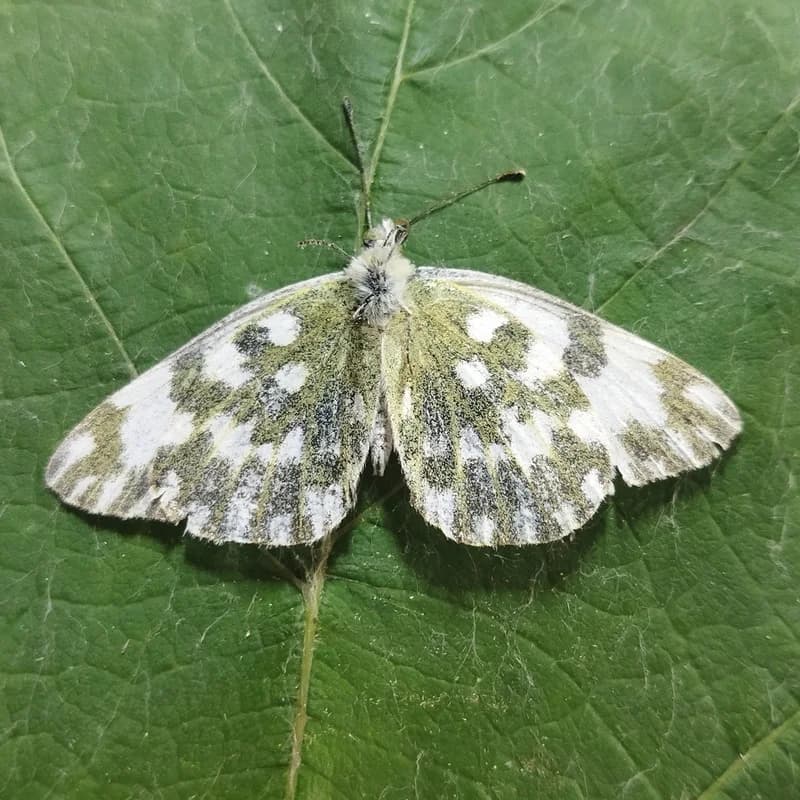
Wingspan 34–48 mm. Both pairs of wings are white with black markings: a large spot in the middle of the forewing, round spots along the upper edge and within these, further a row of dark spots. The female has an additional spot on the forewing and dark markings on the hindwing. Both sexes have a mottled green pattern on the underside of the hindwing, which on the upper side shines through as grey markings.
Similar species
The female of orange tip may resemble Eastern Bath White, but it is otherwise easily distinguished by the pattern on the underside of the hindwing.
Distribution
Found twice in Norway: a hole in Buskerud in 1886, and Sør-Varanger in Finnmark in 2000. It occurs permanently on Gotland and in the south of Denmark; otherwise, it appears as an immigrant in North Europe. Previously classified as Pontia daplidice, it is now considered to be two species; particularly, Pontia edusa migrates and can be found in North Europe.
Biology
The larvae live on various plants in the Asteraceae family and in the dill family, for example, Sisymbrium species. It is bluish-purple with two yellow lines down the back, yellow side lines, and yellow feet, and it grows to 21–25 mm.