
Identifying features
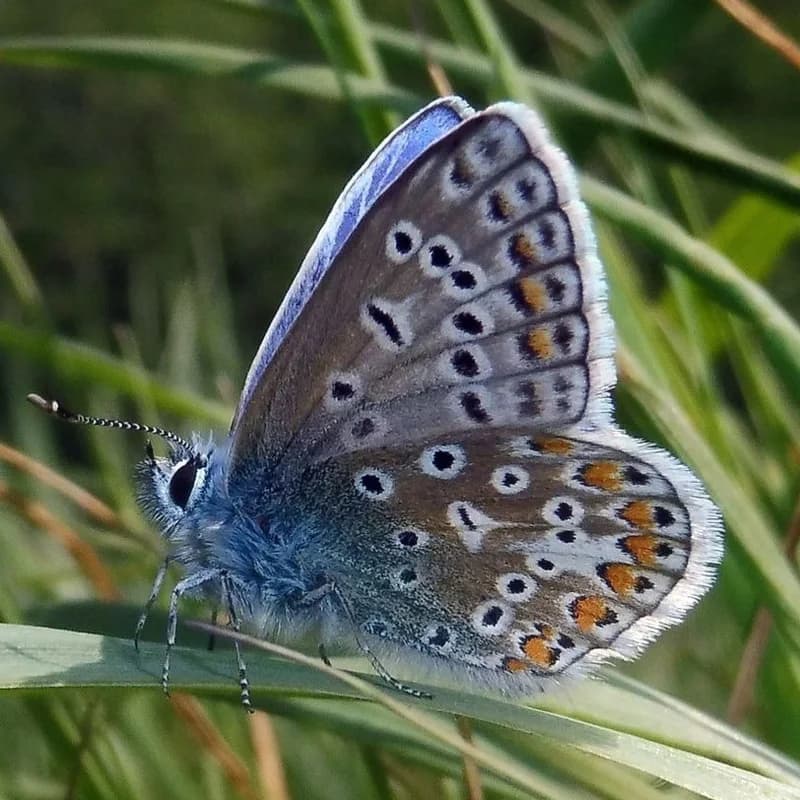
Wingspan typically 21–33 mm (occasionally up to 38 mm in Jotunheimen and Northern Norway). The male has blue uppersides to the wings; the female’s uppersides may be either blue or brown, with orange marginal markings. The grey undersides of the wings have black spots surrounded by white and orange marginal markings. The underside of the forewing typically has from one to three black spots between the disk and the wing base.
Similar species
Can mainly be confused with Northern Brown Argus, which lacks blue colouring, and Amanda’s blue. With some practice, the three species appear quite different from one another (according to the booklet).
Distribution
Common throughout Norway, associated with open areas whether in lowlands or in the mountains. One of the winners in the modern cultural landscape, related to scrap yards/waste land. Approximately 6,750 finds. One of the most widespread blue wing butterfly species in Europe.
Biology
Larval food is most often bird's-foot trefoil, but also some other plants in the pea flower family can be used. Overwinters as a larva in the fourth stage.