
Identifying features
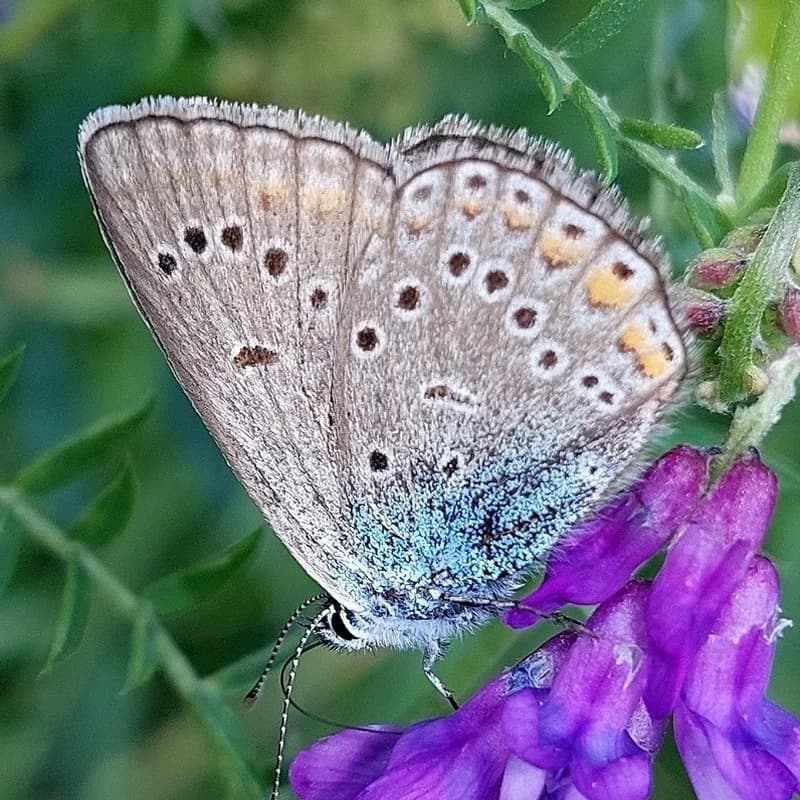
Wingspan 31–36 mm. The male has a turquoise-blue, iridescent upperside; the female is dark brown with bluish patches from the base which may become so dominant that the wings appear blue, and small red-orange, crescent-shaped spots along the outer edge of the hindwing. The underside of the forewing lacks dark spots in the inner half; the underside of the hindwing has faintly yellowish-orange spots.
Similar species
The female can resemble Mazarine blue, but this one has no orange crescent markings on the upper side of its hindwings. The male can resemble common blue, but this one has a white wedge-shaped marking on the underside of its hindwings and stronger orange crescent markings.
Distribution
In suitable locations in the southeast Norway. Also found in Denmark and the southeast Sweden and Finland.
Biology
The eggs are flat with a finely dotted pattern. The larva is greenish with longitudinal stripes. Older larvae have tentacles and a honeydew gland on the seventh abdominal segment.