
Identifying features
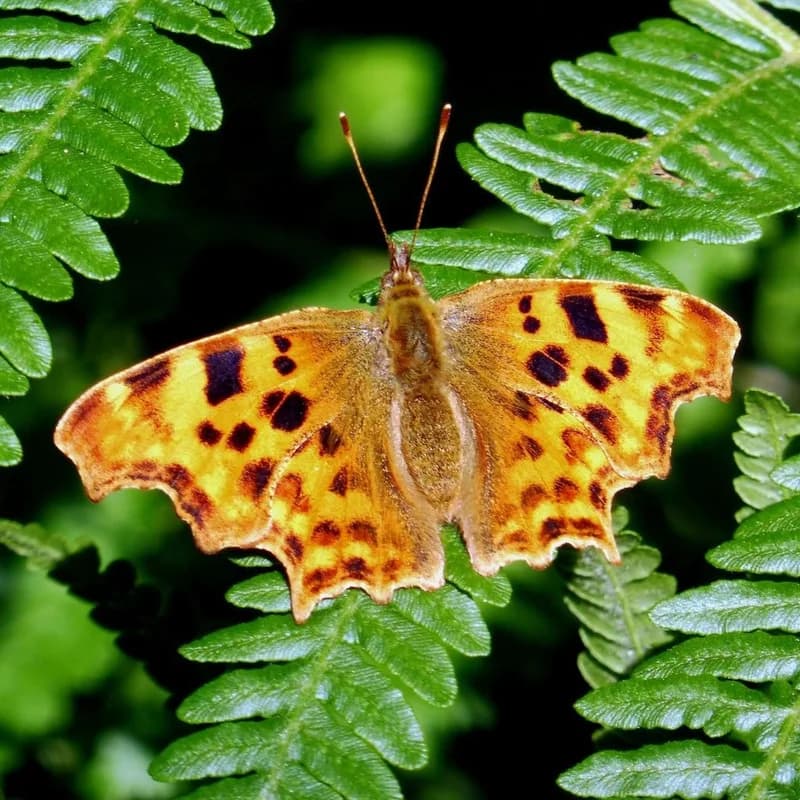
The wingspan is between 4 and 5 cm. The colours are reddish-brown and brown on the upper side of the wings. The underside of the wings is dark brown-black, and on the hindwing underside there is a Comma-shaped figure which has given the butterfly its name. Both wings are strongly fringed at the edges. The larva is grey-black with two red lines on the side; the front part of the back is also red, while the rest of the back is more white.
Similar species
Comma can be very easily confused with large tortoiseshell – often, it’s only the colour of the outer wing edge that differs: Comma has a yellow-brown outer wing edge, while large tortoiseshell has a blue or bluish-tinged one.
Distribution
Quite common in Southern Norway.
Biology
Comma overwinters as an adult and can tolerate some frost if the temperature change occurs gradually. Early in the spring, butterflies that have overwintered lay eggs on host plants as soon as they begin to sprout. The larvae feed on nettle (Urtica), elm (Ulmus glabra), willow species (Salix), hop (Humulus), and various berry bushes such as redcurrant (Ribes rubrum) and gooseberry (Ribes uva-crispus). The pupal stage lasts only a few weeks.