
Identifying features
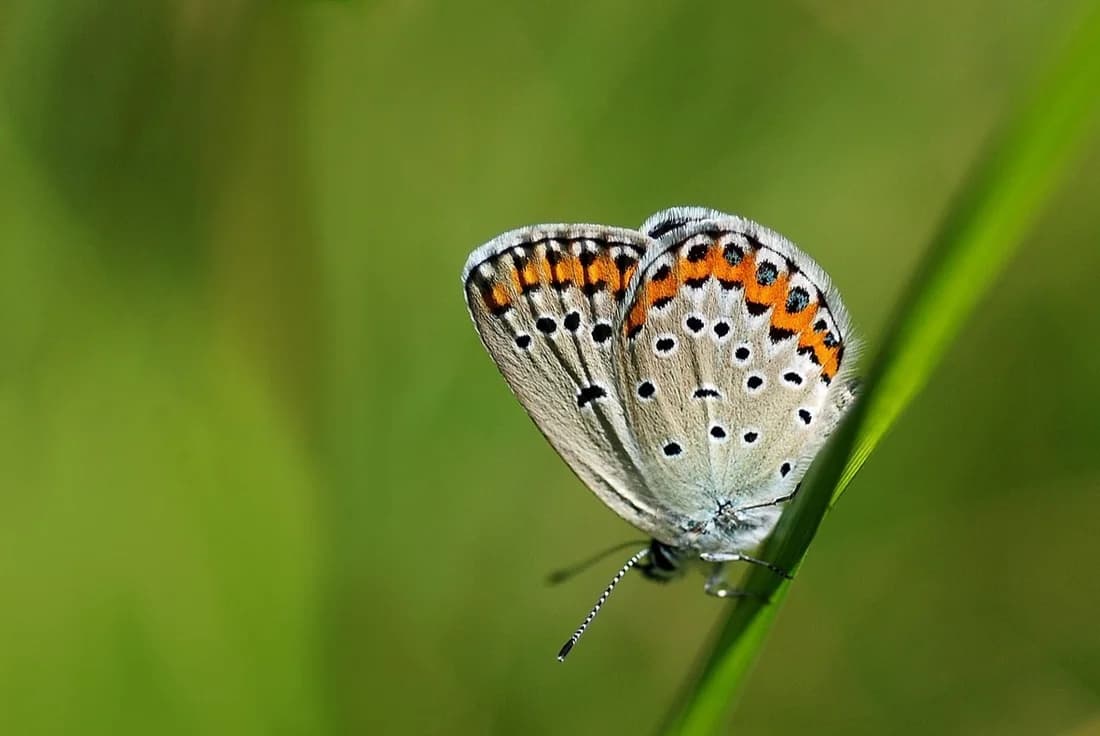
Wingspan 28–34 mm. Resembles both Silver-studded blue and Idas blue, but is somewhat larger and has a lighter underside of the wings. The male has a blue upper side of the wings with a distinct transition to the black area along the wing margin; the female is dark blue with prominent orange crescent shapes along the hindwing margin. The underside of the hindwing has a narrow, yellowish-orange band with a few small, blue, rounded spots.
Similar species
It resembles both Silver-studded blue and Idas blue, but is somewhat larger with a lighter underside on the wings.
Distribution
Historically widespread, but very limited in the inner Oslofjord (Nesøya and Langåra in Asker, Borøya and Ostøya in Bærum). No sightings after 2013; the species is presumed extinct in Norway and is protected. After 2019, it has not been found either in Sweden despite extensive searching.
Biology
Entirely dependent on the pea flower plant Astragalus glycyphyllos as a larval food source. Much of the previously suitable habitat was subsequently destroyed or degraded (through overgrowth, development, and sheep grazing). Over 50 reared individuals were released in 2013, but no sightings of the species have been made since.