
Identifying features
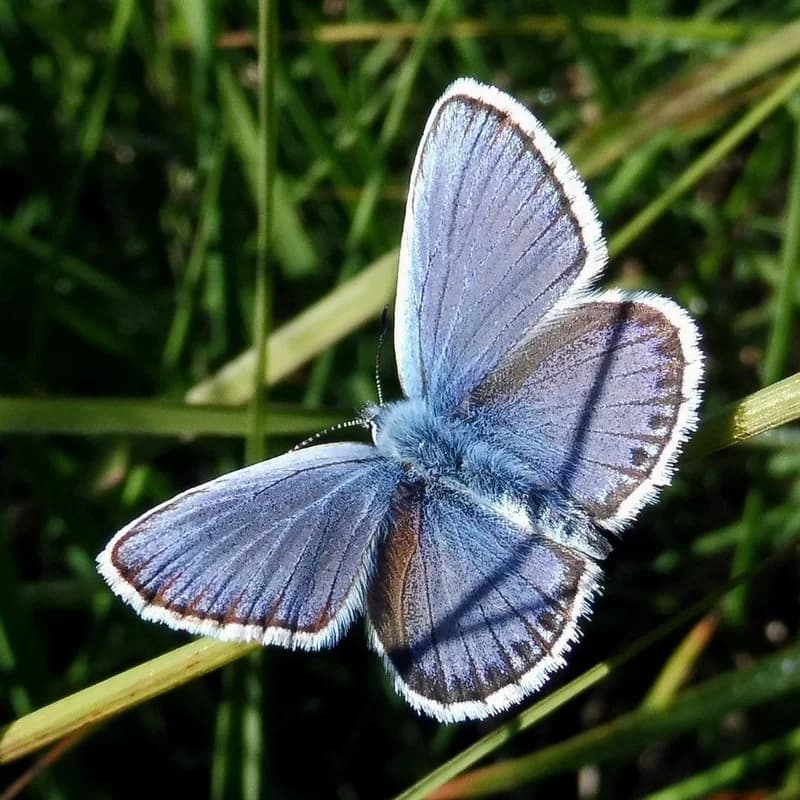
Wingspan 23–27 mm. The male has a blue upperwing surface, gradually transitioning to the black area along the wing margin; the female is dark brown with a suggestion of orange, crescent-shaped markings. The underside of the wing is grey with dark spots within very thin, white rings; the underside of the hindwing features a yellowish-orange band with a few blue, rounded spots. A likely characteristic for distinguishing this species from Idas blue is a small, curved projection at the tip of the forewing.
Similar species
It resembles Idas blue and can be difficult to distinguish from it; the sure characteristic is the curved spur on the front bone, which is missing in Idas blue.
Distribution
In southeastern Norway along the coast of Rogaland; a few finds in Hordaland, Oppland, and Møre og Romsdal. Also found in Denmark, in the southeastern Sweden and Finland, and in Europe extending eastward to Japan.
Biology
The egg is greenish-white, round and flat with a fine dotted pattern. The larva is greenish with longitudinal stripes and a dark midline along the back; older larvae have tentacles and a honeydew gland on the seventh abdominal segment.