
Identifying features
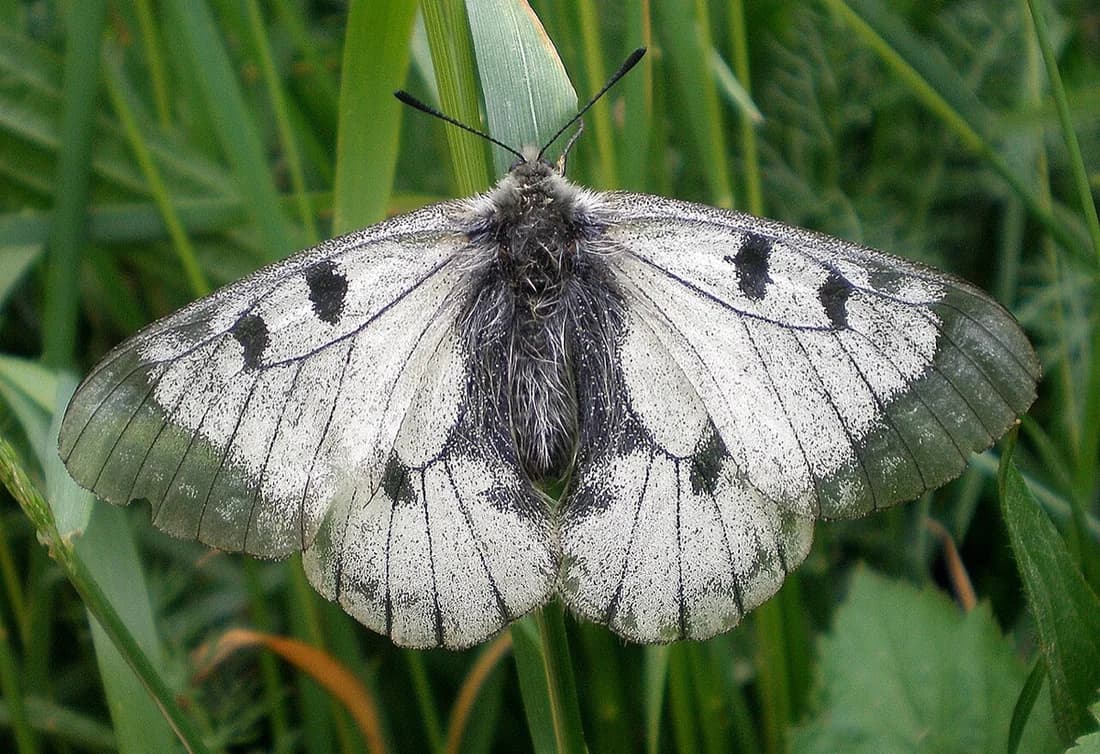
Wingspan 55–68 mm. The wings are white with black veins. The forewing has two black spots along the front edge, while the outer part of the wing is greyish and translucent. The hindwing has dark dusting along the base and at the root. The body is dark with grey-white hairs. The female has stronger dark powdering and more translucent wings than the male.
Similar species
In flight, it may be confused with Black-veined White, but this species lacks the two black spots on the forewing.
Distribution
Known from Norddal, Sunndal, Nesset, and Stranda in Møre og Romsdal, as well as from Luster and Aurland in Sogn og Fjordane, and also from Vinje in Telemark. In Sunndalen, the species also extends as far as the border into Oppdal in Sør-Trøndelag. It was not discovered in Norway until 1936, and occurrences in Telemark were only discovered as late as 2017.
Biology
The eggs are laid randomly in the ground, or dropped during flight. The species overwinters as a fully developed larva inside the eggshell. The larva hatches in April, at the same time as the food plant, Sorbus septima, begins to produce its first leaves, and develops very quickly before the Sorbus septima dies down. The fully grown larva is approximately 4 cm long, velvet black with orange spots along each side of its body; the pupal stage lasts approximately four weeks. The adult butterfly primarily feeds on rowan. After mating, the female develops a sphragis (mating pouch) on the underside of her thorax.