
Identifying features
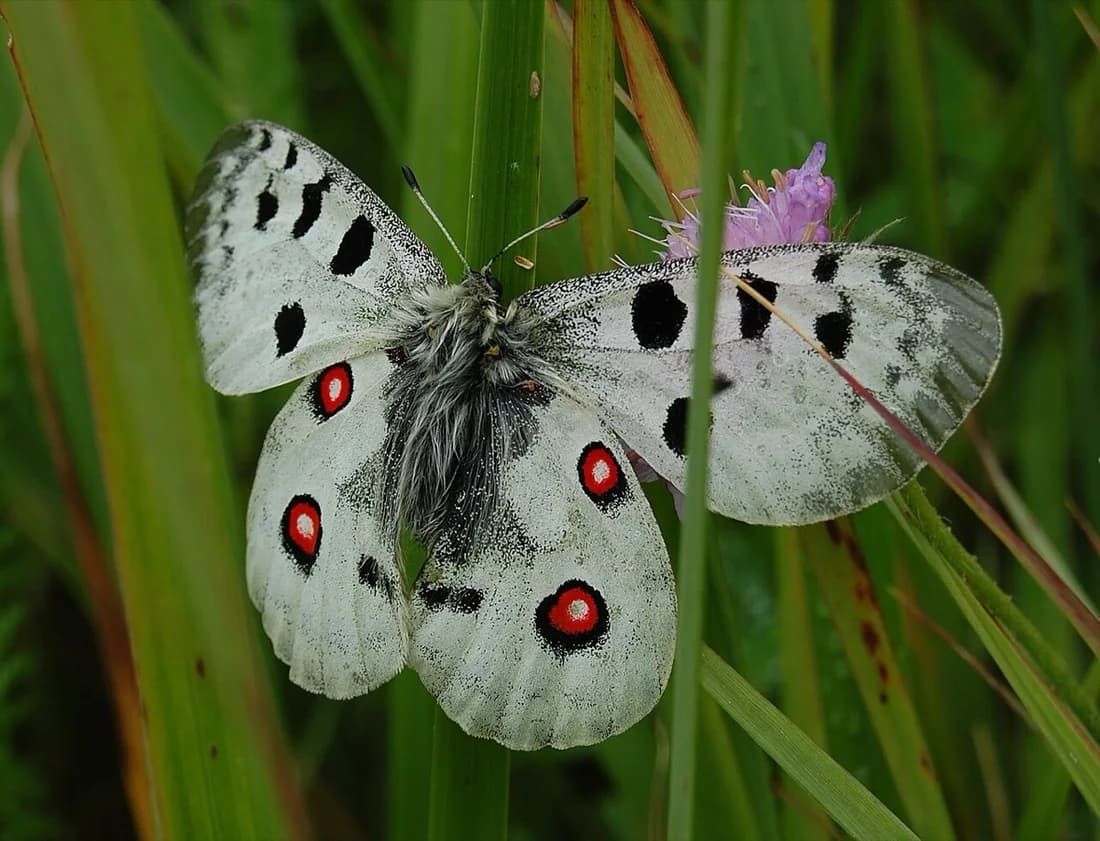
Wingspan 62–90 mm. The wings are white, with varying amounts of dark dusting and partially transparent, especially along the front edge of the wing. The forewing has 4–5 black spots, and the hindwing has two characteristic orange or red eye spots. The body is black with grey hairs. An elegant glider that barely flaps its wings when soaring between flowers.
Similar species
Cannot be confused with any other Norwegian butterfly.
Distribution
It occurs in the valley areas of inner Telemark, in Hallingdal, Numedal, and Gudbrandsdalen, as well as in some locations in the high mountains of Ål, Hol, and Jotunheimen. There are also more recent observations from inner Vest-Agder. Formerly widespread along the coast from the Swedish border to Vest-Agder, but now completely absent from coastal areas. Protected in 1989. Approximately 750 findings according to the booklet from 2025.
Biology
The eggs are laid individually in the ground and overwinter; they hatch early the following spring. The larvae feed on species in the Saxifraga family: in the mountains primarily rosenrot, while the lowland form prefers smørbukk and hvitbergknapp. The fully grown larva is velvet black with a row of reddish-orange spots along each side of its body. The pupa develops in a loose cocoon in the scree; the pupal stage lasts 3–5 weeks. After mating, the female develops a sphragis (mating pouch) on the underside of her thorax.