
Identifying features
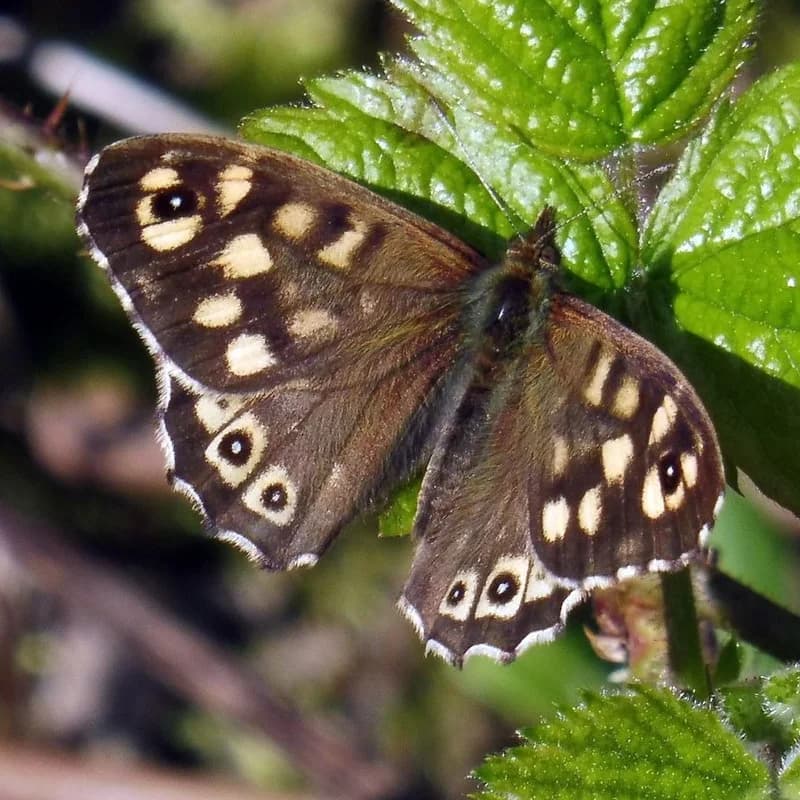
Medium-sized moth with a wingspan of 33–43 mm and relatively slender wings. The outer edge of the wings is clearly wavy. It can be distinguished from all other north European species by the light spots scattered on the upper side of the wings; in the subspecies found in Norway, these are cream-white, while more southern subspecies are more yellow. It has an eye spot at the tip of the forewing and three–four along the edge of the hindwing. The underside of the forewing is yellowish-brown with a darker edge; the underside of the hindwing is mottled yellowish-brown. Eye spots on the underside, as on the upper side, are less distinct on the hindwing.
Similar species
It can be distinguished from all other north European species by the light spots on the wing’s upper side; misidentification is unlikely.
Distribution
The spread in Norway is not described in more detail in the examined sources.
Biology
The males compete for sunlit patches and fiercely defend them, but it has been shown that the male who held the patch originally almost always wins. The larvae live on heather vines (Melica uniflora) and dog grass (Dactylis glomerata).