
Identifying features
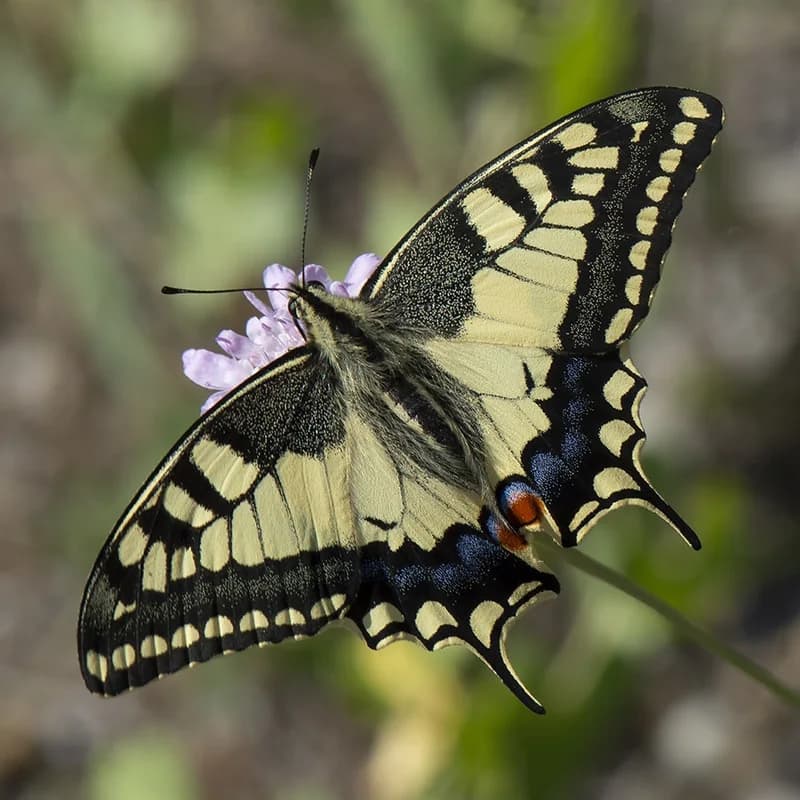
Wingspan 72–90 mm. The base colour is light or warm yellow. The forewing has a black outer edge and three black spots along the front edge; the hindwing has a black outer edge, a row of blue-tinged spots, and a red, ringed eye spot at the rear corner. The hindwing has a characteristic tail that has given the species its Norwegian name.
Similar species
Cannot be confused with any other Norwegian species. The booklet mentions that the similar Iphiclides podalirius is likely to appear in Norway at some point.
Distribution
Widespread throughout the country, but generally occurs sporadically and as single individuals. The primary distribution is in the southernmost regions, and the species is locally common along the coast of East and Southern Norway west to Rogaland. Approximately 5,000 records according to the publication from 2025.
Biology
Eggs are laid singly on plants in the carrot family, in Norway mainly wild angelica, garden angelica and milk parsley. The young larva is black with a white patch on its back, resembling bird droppings. Older larvae are light green with two black transverse bands on each segment, the rear band bearing five orange spots. The larva is poisonous and has a foul-smelling orange defensive organ, the osmeterium, behind its head. Pupation normally occurs in July. The pupa overwinters and emerges the following spring.