
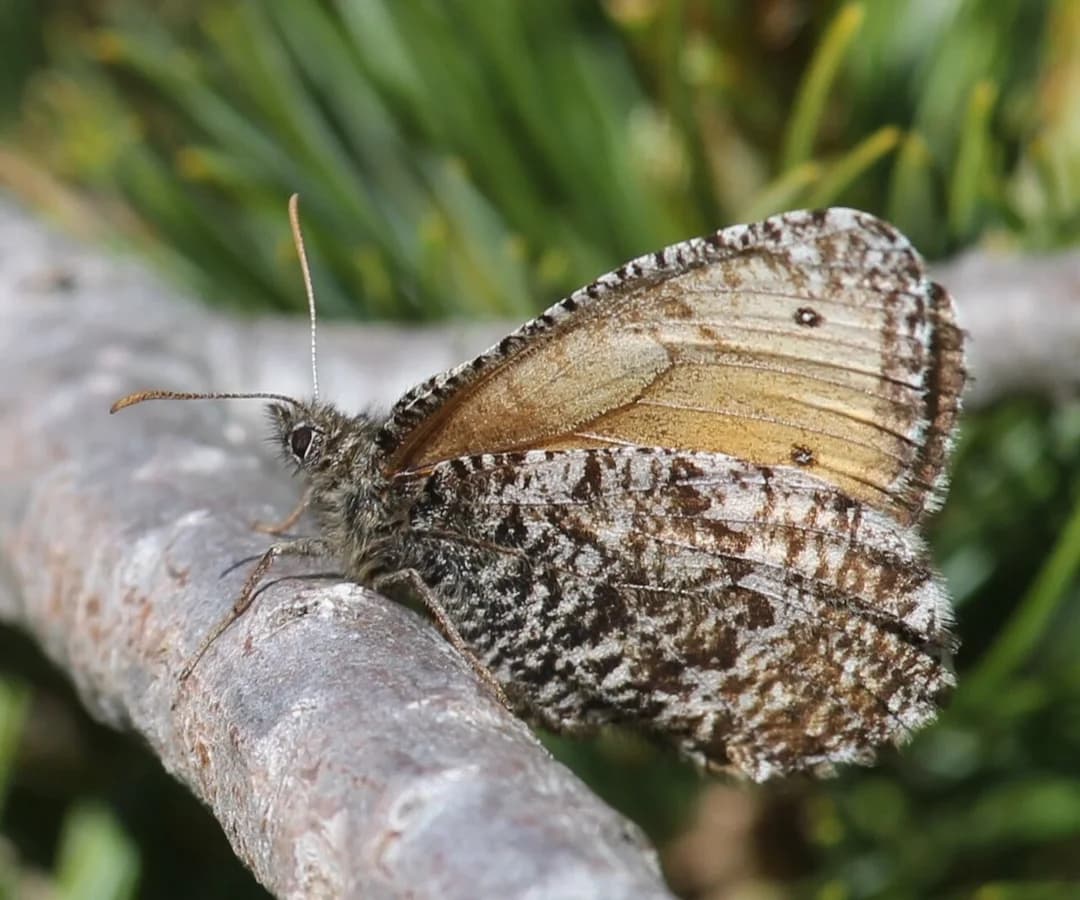
Identifying features
Medium-sized moth with narrow wings. The body is short and noticeably hairy, with relatively short antennae. The upper side of the wings is yellowish-brown with a broad, ochre-yellow transverse band along the wing edge. On this band, there are 2–3 eye spots on the forewing, and often a small eye spot on the hindwing. The underside of the forewing is yellowish-grey with two eye spots; the underside of the hindwing is grey-spotted with a broad, uneven, dark transverse band around the middle, with a wide edge and white on both sides. The larva is light olive-yellow with narrow, reddish-brown longitudinal stripes, light violet-brown lateral stripes, and a yellow head.
Similar species
The distribution overlaps with Jutta Arctic in the north of Eastern Norway and in Trøndelag, but the two species are unlikely to ever occur in the same habitat.
Distribution
Relatively common in the mountains from Dovrefjell and northwards; also found in low-lying areas. In the south, it only flies on grassy patches and clearings in the pine forest, but in the north, it can be found almost everywhere.
Biology
The larvae live on finnish beard (Nardus stricta), mountain grass (Poa alpina), and thyme (Phleum spp.) and other grasses. The larval development takes two years.