
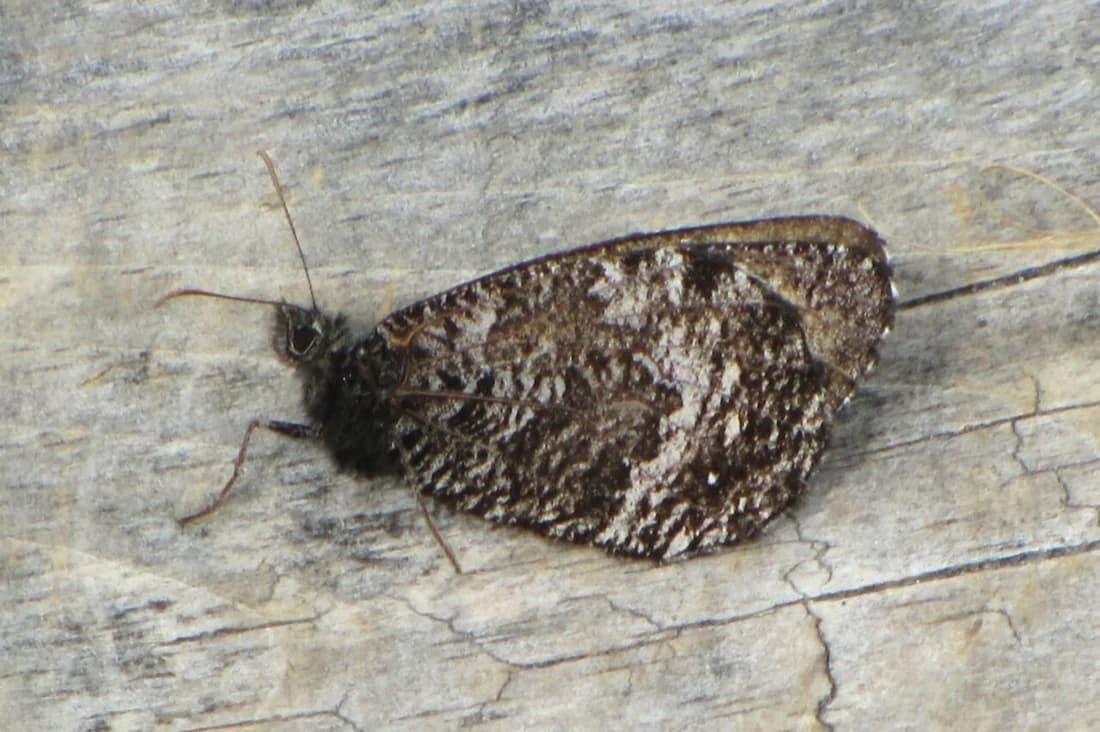
Identifying features
A medium to large butterfly with a wingspan of 50–58 mm. The majority of the wings are patterned in various shades of light brown. Several small eyespots or markings are located in lighter areas on the wings, both on the upperside and underside. The undersides of the hindwings are grey-brown, providing good camouflage when the species characteristically rests on a pine cone, often without casting a shadow. The uppersides of the wings are rarely visible when the butterfly is perched. Males rapidly search pine trunks, inspecting them from base to top, in search of unmated females.
Similar species
The distribution of Norse Arctic ( Oeneis norna) overlaps with the distribution of Jutta Arctic in northern Eastern Norway and in Trøndelag, but the two species rarely occur in the same habitat.
Distribution
Common on mires with pine trees and cotton grass from the inland areas of Østfold to Trøndelag (furthest north in Lierne), and preferably in the eastern parts of the entire region. In 2024, it was observed in Siljan municipality, which represented the first recorded sighting of the species in Telemark. Not observed in Northern Norway. Over 500 sightings.
Biology
Larval food consists of cotton grass. It overwinters as a larva in various stages throughout the species' two-year life cycle. The two-year development appears to be synchronised for the entire population south of Trøndelag.