
Identifying features
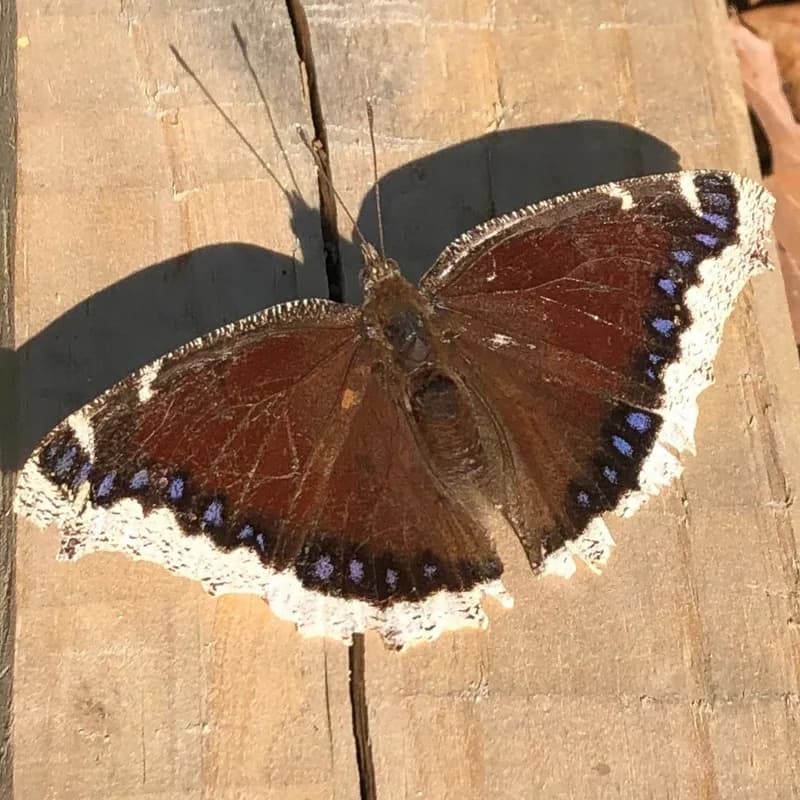
Large, beautiful, and very distinctive species with a wingspan of 61–76 mm. The majority of the upperside of the wings is velvety chocolate brown, but with a row of blue spots near the broad yellow (white after overwintering) band at the outer edge. The undersides of the wings are dark brown with the exception of a broad, dingy white marginal band. It often exhibits a soaring flight quite high in the air, and frequently settles on a tree trunk or on the ground afterwards. It is quite unconcerned.
Similar species
No possibility of confusion.
Distribution
Widespread, but usually not abundant, primarily in low-lying areas east of Southern Norway. More sporadic in Western Norway, in Trøndelag, and in Northern Norway. It appeared that the species had a population peak approximately every ten years, but this pattern has been significantly smoothed out after the peak years of 1996 and 2006. Around 4,300 sightings distributed across all of the country’s counties. It inhabits forest edges and openings in mixed forests where the host trees are present.
Biology
The larva feeds on leaves of young birch and goat willow, and less frequently on other trees such as aspen. The species overwinters as an adult in woodpiles, under fallen trees, among uprooted roots and in tree cavities. It usually avoids flowers, except willow catkins after overwintering, and instead feeds on sources such as damaged birches and fallen fruit. It often rests on gravel roads, where it can take up moisture, minerals and salts.