
Identifying features
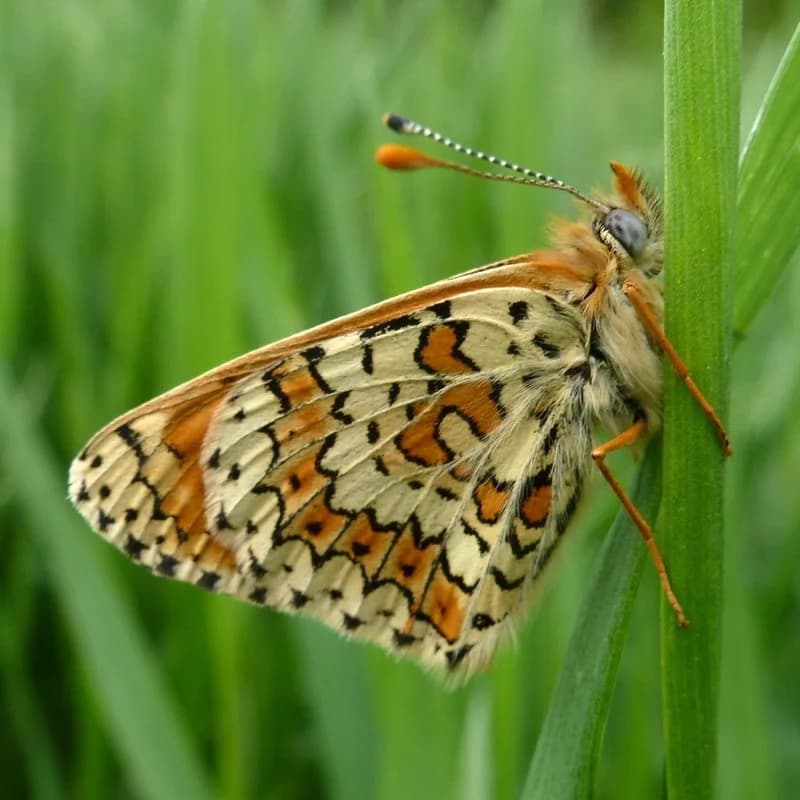
Medium-sized day butterfly with a wingspan of 37–46 mm. There is little variation in colour pattern from individual to individual. The alternation of dark brown and light brown on the uppersides of the wings forms a checkered pattern. The undersides of the forewings are lighter and without any significant checkered pattern. Some large black spots in a field on the upperside of the hindwing, as well as many black spots of varying size and shape in alternating brown-yellow and yellow-white cross-bands on the undersides of the hindwing, are characteristic.
Similar species
Heath fritillary and false heath fritillary are somewhat similar. In flight, they resemble smaller fritillaries and wall brown, but when observed closely, both the upperside and underside of the wings will appear characteristic to someone knowledgeable about butterflies.
Distribution
The species occurred at several coastal sites from the Swedish border (Halden municipality) to Arendal municipality and was also known from a site in Kviteseid in Telemark in the 1930s. Since 2009, when it was last recorded on Tjøme, it has been found in Norway only on the military island of Rauer in Fredrikstad municipality, where a good population remains for now. Most of the more than 1,000 records now concern monitoring larval webs on Rauer in recent years. It has also declined dramatically across much of Europe outside Norway.
Biology
The plant, Vertsplanten, on Rauer is a slender giant – but it is also used, at least, as food for the aksveronika larva. It is particularly susceptible to overgrowth because the larvae are very demanding in terms of temperature, and the species has limited spread due to the approximately 200–300 eggs a female lays during a season, which are distributed across only a few plant clusters. The larvae live in social groups and overwinter in this way, separating as large larvae in the spring. They are vulnerable to parasitic attacks. The adult plants seek nectar from vendelrot and a selection of other nectar plants.