
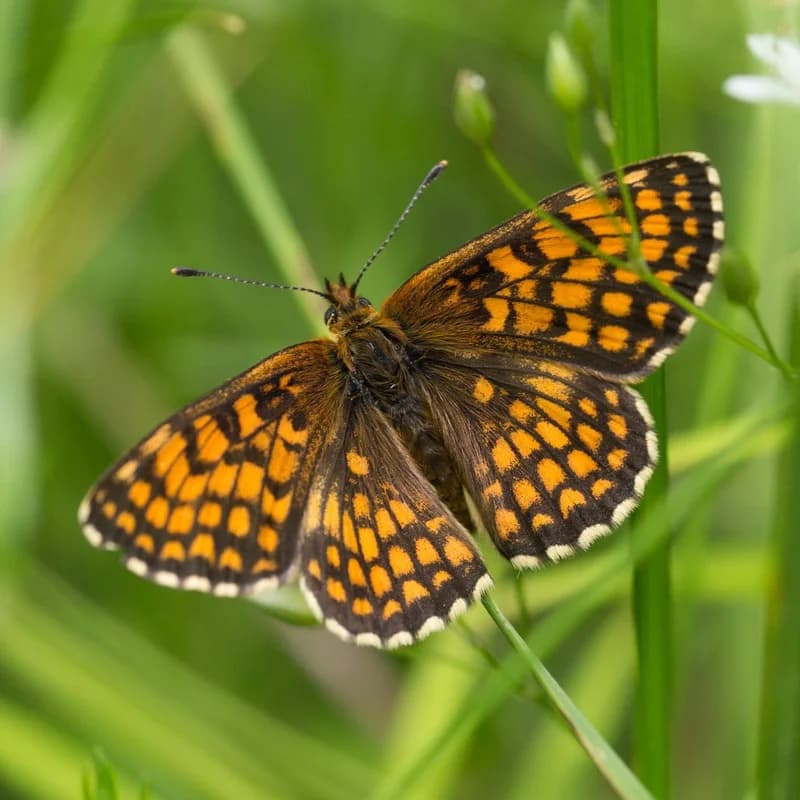
Identifying features
Medium-sized butterfly with a wingspan of 29–48 mm. The colour pattern can vary considerably from individual to individual. The alternation between dark brown and light brown on the upper sides of the wings forms a pattern resembling a grid. The lower sides of the forewings are lighter and without significant grid patterns. The grid pattern on the lower sides of the hindwings is formed by the alternation between reddish-brown and yellowish colour, in addition to thin black lines horizontally and vertically.
Similar species
Reminders in flight, particularly when observed in flight, such as small pearl-bordered fritillary. To reliably distinguish heath fritillary from false heath fritillary, the underside of the hindwing must be carefully examined, paying attention to various characteristics – however, typical specimens of the two species can already be differentiated by the fact that false heath fritillary has darker uppersides of the wings. The undersides of the hindwings of Heath fritillary exhibit lighter markings and a complete absence of black spots closer to the outer edge (in contrast to those found in false heath fritillary).
Distribution
Common in open areas with fresh meadows in the lowlands of Southern Norway and south of Eastern Norway. Records have been made in all counties of the country, with the exception of Rogaland (with a few records nearby). Very few records on the western coast (with the exception of the inland areas of Møre og Romsdal), in Trøndelag (with the exception of the southernmost areas), and in Northern Norway. In Norway, the fritillary has by far the largest distribution and population. It may be abundant in clear-cut areas and along power line corridors. Approximately 2,100 records.
Biology
The plants are marjoram, thyme, and veronica. The caterpillars live in social groups until they complete their second stage. They overwinter as larvae in the third or fourth stage. Specifically, in mountainous areas and in the north, the cycle from egg to adult can take both two and three years.