
Identifying features
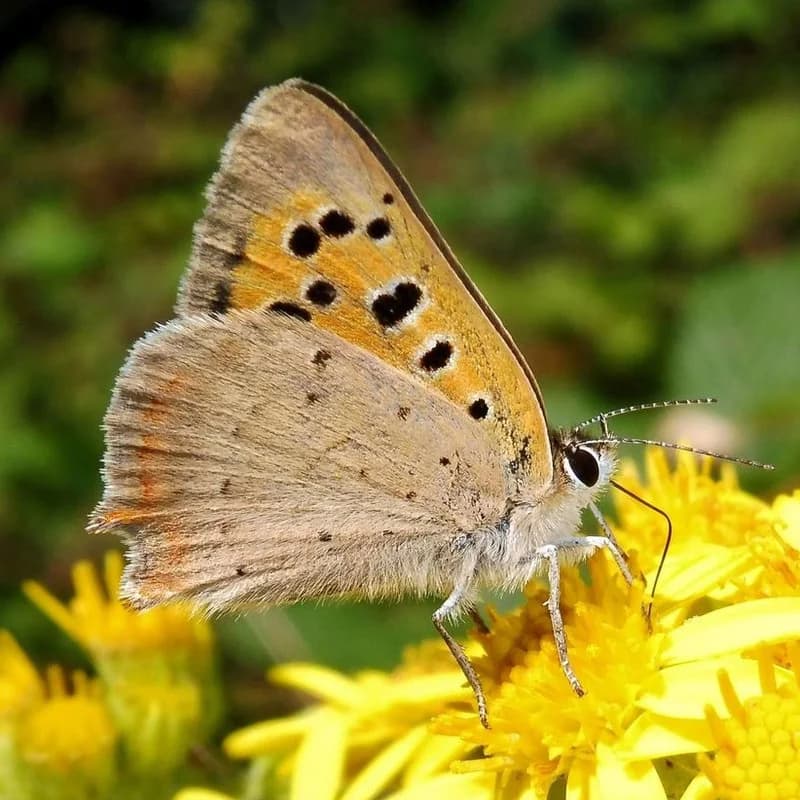
Wingspan 22–34 mm. Newly emerged individuals are strikingly beautiful, with bright orange markings on the upperside of the wings, contrasting with darker areas and spots. The undersides of the forewings are similar to the upperside, while the undersides of the hindwings are consistently brownish-grey. Flight is rapid, and it often lands near where it is first observed.
Similar species
Quite characteristic, but pay slightly more attention to females of scarce copper, even though the underside of this species’ wings is clearly different, featuring, for example, white spots on the rather orange undersides of the hindwings. Also, the uppersides of the wings of females of purple-edged copper resemble those of small copper (brochure).
Distribution
Common throughout Norway, associated with open areas including stone and gravel, from the lowlands up to the boreal forest, as far as the birch forests. Approximately 5,000 finds distributed across all of Norway’s counties.
Biology
The larva feeds mainly on sheep’s sorrel, but also uses common sorrel. It overwinters as a half-grown larva.