
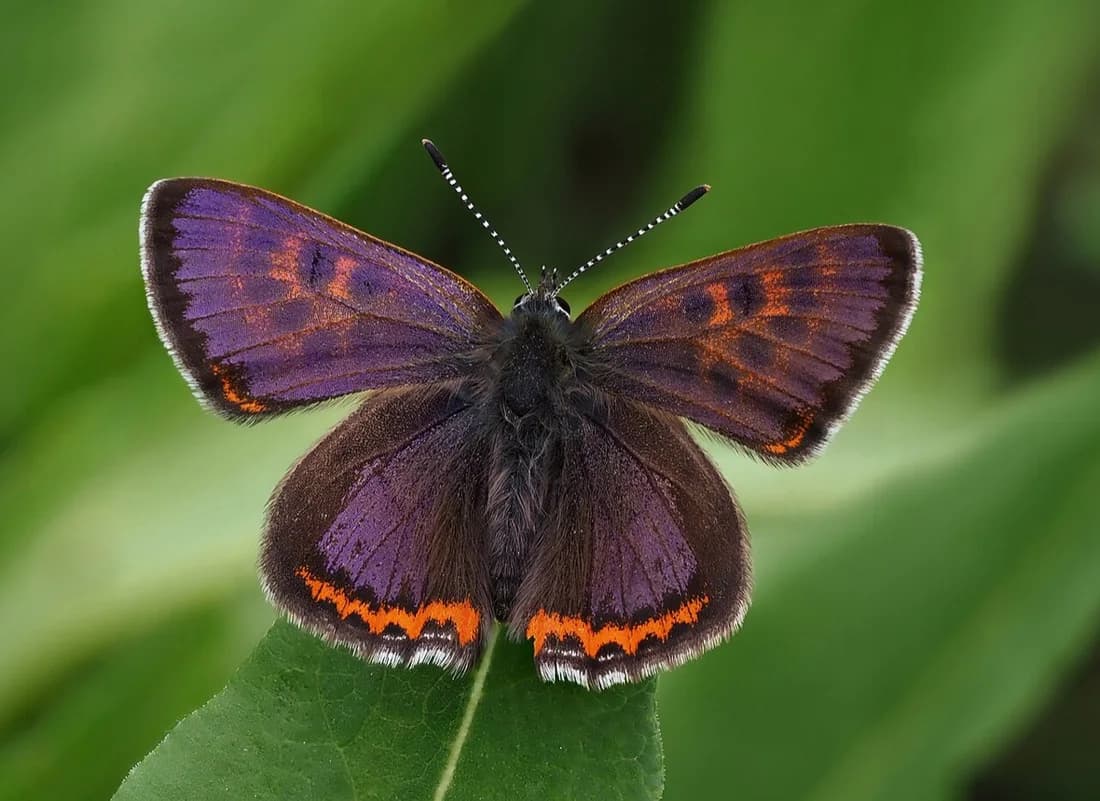
Identifying features
Wingspan is only 22–26 mm. The upper sides of the wings are predominantly dark, with violet hints; the female has more orange on the upper sides of the forewings. The underside of the wings is marked in orange, brownish-grey, black, and white, with many spots of varying sizes. Flight is fast and directly above the ground, which can resemble that of small nocturnal moths.
Similar species
They may resemble something from the dark females of purple-edged copper, but they are significantly larger than Violet copper, and the two species do not occur so frequently in the same habitat type (as stated).
Distribution
Occurs sporadically. A significant concentration of finds from Innlandet (Oppland and Hedmark); older finds in Buskerud; once found in Oslo (1911). No finds from Agder or Vestlandet, and no finds from Eastern Norway. Approximately 300 finds. Listed as strongly threatened (EN); now absent from several locations where it previously occurred.
Biology
The larva feeds on alpine bistort. The species overwinters as a pupa. Adults obtain nectar from various plants; flowers can be scarce in their habitats early in the flight period. Alpine bistort, the host plant, declines markedly 10–15 years after land management ceases. It benefits from late mowing, grazing and the absence of fertilisation.